 Is Now Vyapar TaxOne | Same Trust, New Name!
 AI Weapon for Financial Soldiers
Vyapar TaxOne


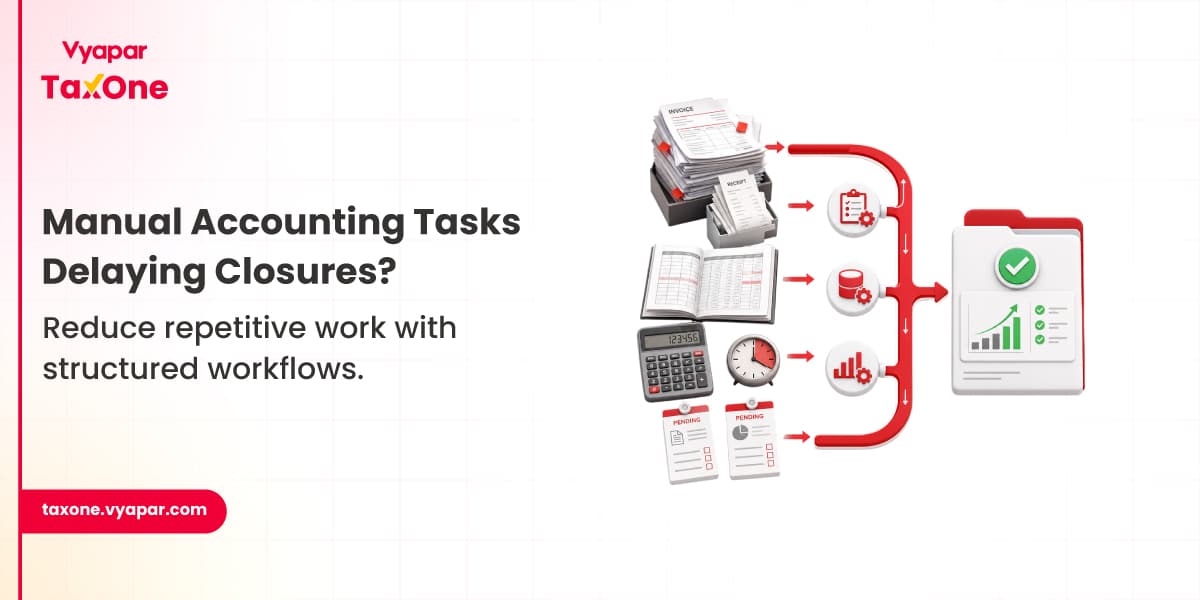
Managing accounting operations becomes challenging when transaction volumes increase. A CA firm handling multiple clients, GST practitioners managing several GSTINs, or finance teams closing books every month often face the same issues, delayed document collection, pending reconciliations, repeated data entry, and last-minute compliance pressure.
Most teams already have accounting software in place. The challenge is not recording transactions anymore. The bigger challenge is managing the workflow around those transactions.
For example, a finance team may receive invoices through emails, WhatsApp messages, and shared folders. Someone then verifies documents, enters data into accounting software, checks GST details, and follows up for missing information. When this process runs across hundreds or thousands of transactions, delays and errors become difficult to avoid.
This is where accounting automation tools become relevant.
These tools help accounting teams reduce repetitive tasks, organize financial data, improve reconciliation workflows, and create better visibility into pending activities. However, the right choice depends on the type of work being handled.
Some tools are better suited for business accounting, while others focus more on CA practices, GST workflows, reporting, or financial operations.
Many firms begin by introducing automation into repetitive accounting activities before expanding it across larger finance workflows. Understanding how accounting process automation works can make it easier to evaluate these tools based on actual operational needs.
Here are some accounting automation tools in India that accounting professionals commonly evaluate based on their workflow requirements.
| Tool | Best Suited For | Key Workflow Area |
|---|---|---|
| Vyapar TaxOne | CA firms and tax professionals | Data migration, reconciliation, GST workflows |
| Zoho Books | Small businesses and finance teams | Accounting, invoicing, reporting |
| ProfitBooks | SMEs managing inventory and accounts | Billing and financial tracking |
| Refrens | Businesses managing invoicing workflows | Billing and compliance documentation |
| RealBooks | Growing businesses and finance teams | Accounting and reporting |
CA firms often spend significant time collecting client documents, preparing accounting data, checking mismatches, and completing GST-related activities. When these tasks are handled manually, the workload increases quickly, especially during month-end closing and filing periods.
Vyapar TaxOne is designed around these accounting workflow challenges faced by CA firms and tax professionals.
The platform helps teams manage processes such as document collection, accounting data preparation, reconciliation activities, and GST workflow management in a more structured manner.
For firms handling multiple clients, the biggest challenge is often not accounting knowledge but managing volume. As client numbers increase, teams need better control over document movement, reconciliation status, and pending tasks.
Tools like Vyapar TaxOne fit into this shift toward structured accounting workflows, where teams move beyond scattered spreadsheets and manual follow-ups.
Zoho Books is widely used by small businesses and finance teams that need a centralized system for accounting, invoicing, expenses, and reporting.
For businesses managing regular transactions, one common challenge is keeping invoices, expenses, payments, and bank records updated without continuous manual tracking.
Zoho Books works well for businesses that need structured accounting records without managing multiple disconnected files. For finance teams, having sales, expenses, and reports available in one system reduces dependency on manual spreadsheets.
However, larger accounting practices handling multiple clients may require additional workflow controls beyond regular bookkeeping.
ProfitBooks is an accounting platform focused on helping small and growing businesses manage accounting, billing, and inventory-related activities.
For businesses where sales and inventory movement directly affect accounting records, maintaining accurate data flow becomes important.
Businesses managing inventory along with accounting often face challenges when stock records and financial entries do not match. A connected accounting workflow helps reduce manual tracking between sales, purchases, and inventory records. ProfitBooks can be useful for businesses looking for accounting and inventory management within a single system.
Refrens focuses on simplifying invoicing, billing, expense tracking, and business documentation workflows.
For many growing businesses, accounting issues begin before the accounting entry itself, incomplete invoices, delayed approvals, missing payment records, and scattered documentation.
Refrens can help businesses maintain better control over billing-related workflows. When invoice creation, payment tracking, and documentation happen through structured processes, finance teams spend less time searching for missing information.
For businesses improving their accounting discipline, tools like these help create consistency in daily financial operations.
RealBooks is an accounting platform used by businesses looking for accounting, reporting, and financial management capabilities.
Finance teams often struggle when financial information is spread across different files, systems, and departments. A centralized accounting system helps bring important records together.
RealBooks can support businesses that need better control over financial data and reporting processes. When teams have access to updated information, reviewing transactions and preparing reports becomes easier.
Understanding how accounting process automation works can make it easier to evaluate these tools based on actual operational needs before selecting a platform.
For finance departments managing regular accounting activities, structured data management can reduce dependency on manual tracking methods.
Small businesses often manage daily accounting activities through a combination of invoices, payment records, inventory details, and manual follow-ups. As transaction volume increases, maintaining updated records across different files becomes difficult.
Vyapar is an accounting software designed for small businesses to manage regular business transactions, billing, inventory, and financial records.
For small businesses, many accounting problems begin with inconsistent record keeping, disconnected records, and delayed financial updates. When sales, expenses, and inventory details are maintained separately, finance teams spend more time verifying information.
Vyapar helps businesses bring these activities into a more organized accounting workflow, especially where owners or small teams manage daily financial operations themselves.
myBooks is an accounting platform used by small businesses, entrepreneurs, and professionals who need support with invoicing, expense tracking, and financial reporting.
For smaller teams, the challenge is often maintaining accurate books while handling daily business activities. Manual bookkeeping can become difficult when transactions increase and financial records need regular updates.
Businesses that still rely heavily on manual bookkeeping often face delays during reporting periods. Having accounting records available in one system makes it easier to review transactions and prepare financial summaries.
myBooks can support businesses looking for a simpler accounting workflow without managing multiple disconnected records.
Giddh focuses on cloud-based accounting workflows, helping businesses manage accounting records, reporting, and financial information from a centralized platform.
As businesses grow, finance teams often face challenges around maintaining consistent records across departments and ensuring everyone works with updated information.
For businesses with multiple people involved in accounting activities, controlling access and maintaining updated records becomes important.
A centralized system reduces dependency on scattered spreadsheets and makes financial information easier to review during internal checks or reporting cycles.
Saral Accounts is an accounting and billing software used by businesses that require support for accounting, inventory, taxation, and reporting activities.
Businesses dealing with regular purchase, sales, and inventory transactions often need better coordination between operational records and accounting entries.
When purchase, sales, and inventory records are managed separately, businesses may face delays during reconciliation and reporting.
Saral Accounts helps businesses maintain connected workflows where operational activities and accounting records can be reviewed together.
AlignBooks is a cloud-based accounting platform designed for businesses looking to manage accounting, billing, inventory, and reporting activities through a single system.
Growing businesses often need more structured processes as transaction volumes increase.
Managing financial information through multiple files can make tracking approvals, expenses, and reports difficult.
For businesses moving from manual processes toward digital accounting, having a structured system can improve visibility into daily operations.
AlignBooks can help teams organize accounting activities while reducing dependency on manual tracking methods.
Choosing an accounting automation tool is not only about the number of features available. CA firms and finance teams usually evaluate tools based on the workflow problems they need to solve.
For example:
A firm handling five clients may manage these activities manually. But when the number of clients increases, the same process becomes difficult to control.
We often see accounting teams facing issues during:
The challenge is usually not accounting knowledge. It is maintaining accuracy and visibility when the volume of work increases.
Many CA firms still depend on Excel sheets, emails, WhatsApp follow-ups, and manual tracking to manage client workflows.
This approach may work initially, but problems start appearing when:
A structured workflow helps teams know:
This is where accounting automation tools become valuable.
The right tool depends on the type of workflow a team is trying to improve. Some businesses need better invoicing control, while CA firms may need stronger support around document collection, reconciliation, and accounting data preparation.
You can merge both sections like this while keeping the tone observational and avoiding a sales-heavy ending:
CA firms usually do not move toward automation because they want another software dashboard. The shift usually happens when manual coordination starts affecting accuracy, turnaround time, and the ability to handle growing workloads.
When teams manage multiple clients, accounting data often comes from different sources, Excel files, invoices, PDFs, bank statements, and client communication channels. Managing this information manually can lead to missing documents, delayed follow-ups, reconciliation gaps, and additional review efforts during compliance cycles.
These challenges become more visible as transaction volumes increase. A process that works for a few clients may become difficult to control when firms handle multiple GSTINs, frequent reconciliations, and tighter filing timelines.
This is the kind of workflow gap that pushes accounting teams toward more structured systems like Vyapar TaxOne.
Vyapar TaxOne helps CA firms and tax professionals organize accounting workflows around areas such as data preparation, document collection, reconciliation activities, and compliance-related processes. The focus is not just on reducing manual work but on creating better visibility into pending tasks, accounting data movement, and workflow status.
The broader shift in accounting is toward systems that help professionals spend less time managing repetitive coordination and more time on review, analysis, and advisory activities.
As accounting data becomes cleaner and more structured, firms are also finding it easier to use AI for financial analysis and forecasting to support planning and decision-making.
Firms looking to understand how structured accounting workflows can fit into their existing processes can explore Vyapar TaxOne through a free trial.
Many firms already have established processes. The challenge is identifying repetitive tasks that can be structured without disrupting daily operations.
Automation can help teams organize data, identify gaps, and reduce manual checking efforts, especially when transaction volumes increase.
Many firms use structured collection processes because relying only on emails and messages can make tracking pending documents difficult.
Teams should evaluate workflow compatibility, data handling, reporting needs, and whether the tool supports their existing accounting processes.
Accounting automation can reduce repetitive work, but professional review remains important for verification, compliance decisions, and exceptions.


Tax Professional & Business Finance Expert
Tax Professional & Business Finance Expert
Tax Professional & Business Finance Expert