 Is Now Vyapar TaxOne | Same Trust, New Name!
 AI Weapon for Financial Soldiers
Vyapar TaxOne


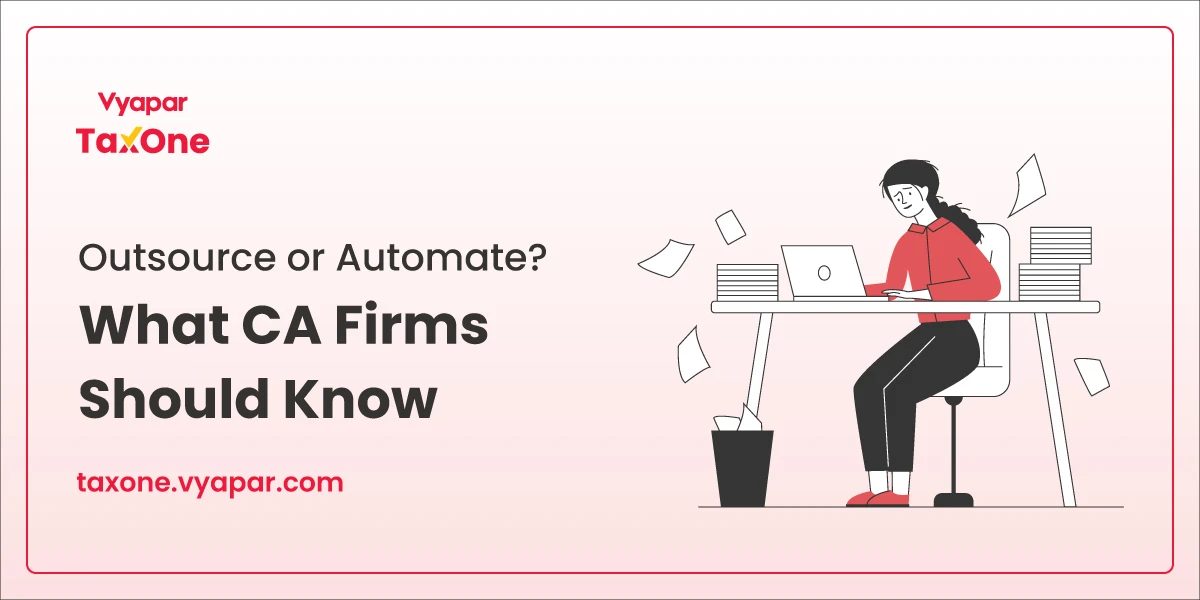
Accounting automation works best for CA firms handling high transaction volumes seeking long-term control and scalability, while outsourcing suits those prioritizing immediate cost relief and operational flexibility.
For most Indian CA firms, the real win isn't choosing one; it's understanding which handles your specific workload profitably.
Most Indian CA firms face a false binary choice. Consultants push either full automation or complete outsourcing, ignoring the reality: automation requires upfront investment and internal capability, while outsourcing surrenders control and locks you into recurring costs.
The consequence? Firms waste money on the wrong solution and later regret the switch.
Here's what actually happens:
A firm with 50 client accounts implementing accounting automation spends ₹2–5 lakhs upfront but recovers the cost within 8–12 months. A similar firm outsourcing the same work spends ₹40,000–₹1,00,000 monthly but has no assets or processes to show after three years of payments.
| Factor | Accounting Automation | Outsourced Services |
|---|---|---|
| Initial Investment | ₹1–4 lakhs (software, setup, training) | ₹0–₹20,000 (onboarding only) |
| Monthly Cost (Year 1) | ₹5,000–₹15,000 (licenses) | ₹40,000–₹1,00,000 (depending on complexity) |
| Cost Per Transaction | Decreases with volume | Stays constant or increases |
| 3-Year Total Cost | ₹3.5–5 lakhs | ₹14.4–36 lakhs |
| Break-Even Timeline | 6–12 months | No break-even; costs persist |
What this means: For a firm managing 200+ invoices monthly, accounting automation breaks even within a year. For fewer than 50 invoices per month, outsourcing remains cheaper for 2–3 years.
Accounting automation isn't just one tool; it's a workflow. Tools like Vyapar TaxOne automate the complete bookkeeping cycle:
Clients submit invoices, bank statements, and ledgers via WhatsApp. Vyapar TaxOne sends automated reminders if documents are missing. No chasing, no delays.
AI-powered sorting separates sales invoices, purchase invoices, Excel sheets, and bank statements without manual intervention.
Banking, sales, and purchase data are smart-tagged and converted into accurate ledgers. Direct Tally integration means one-click verification. Manual data entry? Reduced by 75%.
Validated data flows directly into GST forms. Accounting automation handles reconciliation, reducing human errors and compliance risk.
Real impact on your firm: Your team shifts from data entry (4–6 hours per client) to exception handling and advisory (1–2 hours per client). That freed capacity to take more clients or increase billable hours on advisory work.
Outsourced accounting services (typically ₹40,000–₹3,00,000/month in India) handle full bookkeeping, payroll, and tax filing. The vendor becomes your extended team.
Choose accounting automation if:
Automation timeline: 4–6 months to full efficiency, then 3–5 year payoff.
Choose outsourcing if:
Outsourcing timeline: Immediate impact, but ongoing cost dependence.
The strongest CA firms don't choose; theyblend both strategies:
Example workflow:
Result: Cost is lower than pure outsourcing, efficiency is higher than pure automation, and your team develops expertise instead of losing it.
Month 1: Setup (₹1–3 lakhs investment)
Month 2–3: Testing & Adjustment
Month 4 onwards: Full Operation
Staff impact:
Both approaches carry risks, but different ones.
Accounting automation risks:
Outsourcing risks:
Accounting automation is the better long-term strategy for growing practices. It builds asset value (processes, systems, documentation), creates scalability without proportional hiring, and delivers ROI in 8–12 months for medium to high-volume firms.
Tools like Vyapar TaxOne automate the entire bookkeeping cycle, from document collection to GST filing and integrate with Tally, making implementation smoother for Indian CA firms already using Tally.
Outsourcing is the faster, lower-risk option for firms at immediate capacity limits. It's ideal for specialized work or for small practices where the upfront cost of automation hasn't yet been justified.
The winning move: Start with automation for standardized, routine tasks (using Vyapar TaxOne for Tally-integrated automation), then selectively outsource complex exceptions that require senior expertise. This hybrid approach gives you cost control, internal capability, and external knowledge where you need it most.
The firms that want to thrive in 2026 won't be purely automated or purely outsourced; they'll use both, strategically.
No. Automation eliminates repetitive tasks, freeing your team to focus on higher-value advisory work and client relationships; firms using accounting automation scale client capacity without proportional hiring.
For firms with 20+ clients processing 100+ invoices monthly, ROI comes within 8–12 months. For smaller practices, outsourcing stays cheaper for 2–3 years.
No. Large firms often outsource specialized tasks (complex international accounting, multi-currency payroll) while automating routine bookkeeping. The choice depends on task type and volume, not firm size.
Yes, but it carries costs. Switching requires contract exit fees, data migration time, and temporary process disruption. Choose cautiously, but don't let fear paralyze you; most firms find their right approach within 3–6 months.
Yes. Many successful firms use Vyapar TaxOne for routine bookkeeping and outsource complex advisory work. This hybrid approach delivers cost efficiency plus expertise where needed most.

Tax Professional & Business Finance Expert
Tax Professional & Business Finance Expert
Tax Professional & Business Finance Expert