 Is Now Vyapar TaxOne | Same Trust, New Name!
 AI Weapon for Financial Soldiers
CA


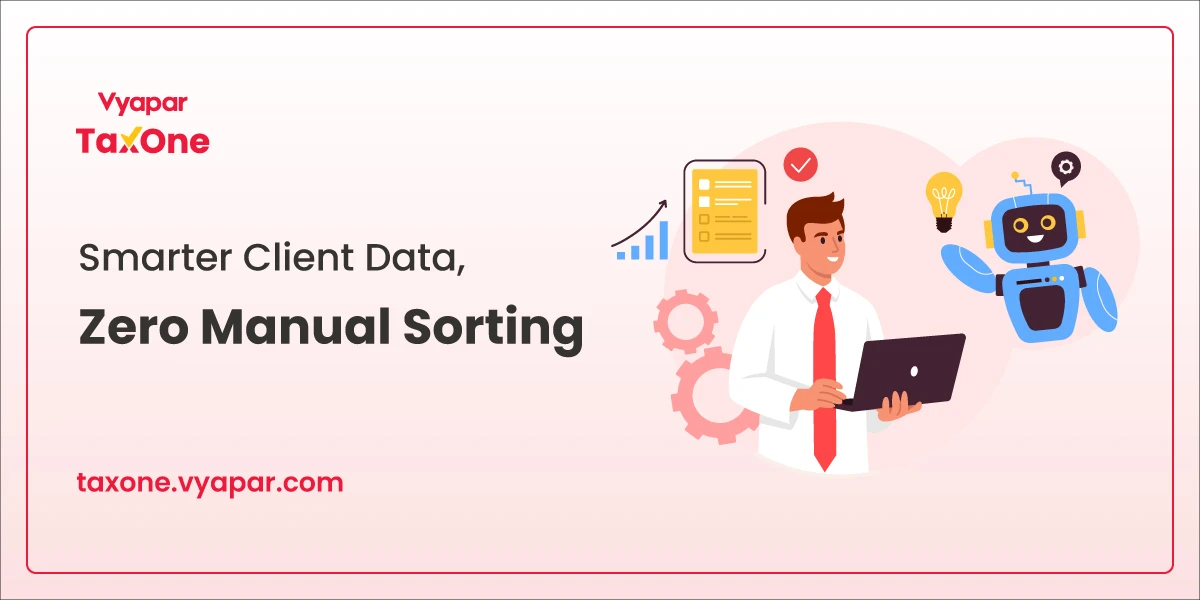
AI has the potential to significantly improve client data management and document classification for tax professionals by automating data processing, reducing human error, and enhancing operational efficiency.
By adopting AI-powered tools, tax firms can streamline workflows, ensuring faster, more accurate client interactions while minimizing errors in critical tasks such as tax filings and documentation.
For many tax professionals, the idea of implementing AI solutions can feel overwhelming. The misconception that AI is only for large firms or that it requires a total system overhaul is common.
However, AI is now more accessible and scalable than ever before. It doesn't require a complete rework of existing systems but can be integrated incrementally to improve specific tasks such as client data organization or document sorting.
What often gets missed is AI's ability to handle these tasks efficiently without compromising data security, which is paramount in the tax field.
Furthermore, tax professionals sometimes overlook how AI can help with regulatory compliance and mitigate the risk of audits due to improper document management.
To make the most out of AI in a tax firm, here's a practical framework for leveraging AI for both client data management and document classification:
AI tools equipped with machine learning algorithms categorize data based on predefined keywords or document types. As the system processes more documents, it "learns" patterns and becomes increasingly accurate over time, ensuring data is categorized correctly and efficiently.
Practical Steps:
Optical Character Recognition (OCR) powered by AI can read text from scanned documents, turning them into digital data that's easy to process and store. This technology helps you extract relevant information, like names, dates, and tax amounts, from receipts and other documents, saving time on manual data entry.
Practical Steps:
By integrating AI with client management software, tax professionals can create profiles that update automatically as new documents are received. This means no more manual updates or fear of missing client documents.
Practical Steps:
AI goes beyond simple folder systems to classify documents based on their content. Natural Language Processing (NLP) technology enables AI to understand the context of each document and classify it accurately, even when it's highly specialized, such as tax returns or legal contracts.
Practical Steps:
AI-powered systems help maintain data security by automatically encrypting sensitive information. Additionally, AI can assist with compliance by flagging documents that may contain irregularities or require tax-related review.
Practical Steps:
| Benefit | Description |
|---|---|
| Increased Efficiency | Automation of repetitive tasks saves time, allowing professionals to focus on higher-value activities. |
| Reduced Errors | Minimizes human errors in data entry, reducing the risk of mistakes that could affect tax filings. |
| Faster Client Interactions | AI-driven systems enable quicker document retrieval and response times for clients. |
| Regulatory Compliance | Automates encryption and compliance checks, reducing the risk of audits or legal issues. |
| Scalability | AI systems can scale easily to accommodate increasing volumes of data and clients. |
When tax professionals think about AI for client data management and AI for document management, they need tools that go beyond words and deliver real-world automation, accuracy, and workflow integration.
Vyapar TaxOne fits this need as a purpose-built practice management and AI‑powered accounting platform designed for Chartered Accountants, tax consultants, and accounting firms.
Vyapar TaxOne isn't a generic AI tool; it specifically addresses the everyday challenges of tax professionals:
Instead of separate, disconnected tools, Vyapar TaxOne covers the whole workflow:
Vyapar TaxOne goes beyond organization; it supports compliance and accuracy:
For practices juggling multiple clients and team members:
Tax professionals using Vyapar TaxOne report significant efficiency gains:
Vyapar TaxOne combines AI for client data management and AI for document management into a unified platform that helps tax professionals reduce manual effort, improve accuracy, and streamline workflows, transforming how modern practices handle data and client documents.
The integration of AI into client data management and document classification doesn't just streamline tax professionals' workflows; it also enables them to deliver better service to clients while ensuring compliance with ever-evolving tax laws.
The future of tax practices is one where technology empowers professionals to focus on high-impact activities rather than manual, error-prone tasks.
Also Read: Top 10 Cloud-Based Data Entry Automation for CA Firms
AI automates data extraction and categorization, reducing manual work and errors. Tools like Vyapar TaxOne help streamline document classification and ensure accurate, real-time client profiles.
Yes, AI uses Natural Language Processing (NLP) to accurately understand and classify complex tax documents, improving on manual classification methods.
AI automates compliance checks and ensures data integrity. Vyapar TaxOne offers encrypted storage and flags compliance issues to meet regulatory requirements.
Vyapar TaxOne automates document extraction and classification, reducing manual entry time and ensuring client files are properly organized for easier access.
Yes, Vyapar TaxOne is scalable and can grow with your firm, automating key tasks while simplifying document and data management.

Tax Professional & Business Finance Expert
Tax Professional & Business Finance Expert
Tax Professional & Business Finance Expert