 Is Now Vyapar TaxOne | Same Trust, New Name!
 AI Weapon for Financial Soldiers
Vyapar TaxOne


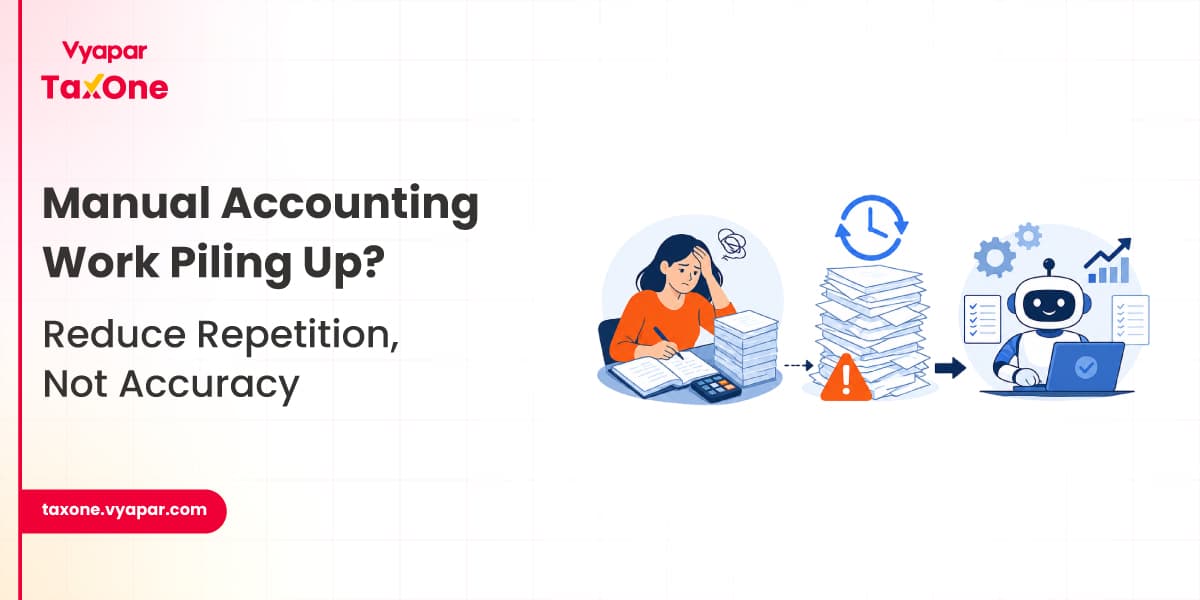
During GST filing periods, accounting teams often spend more time preparing data than completing the actual compliance work.
Invoices arrive from multiple sources. Vendor data needs verification. Purchase registers require reconciliation. Reports must be generated. Supporting documents need to be checked before filing.
The challenge is not usually GST filing itself.
The challenge is the amount of repetitive work that happens before filing can even begin.
We often see accountants spending hours every month on invoice entry, reconciliation preparation, report compilation, vendor follow-ups, and document verification. As transaction volumes increase, these activities start consuming a significant portion of the team's time.
Accounting automation means reducing the manual effort involved in recurring accounting activities such as invoice processing, GST reconciliation, ledger verification, report preparation, compliance tracking, and document management.
The purpose is not to remove human review.
The purpose is to reduce the amount of time spent on repetitive preparation work so accountants can focus on reviewing exceptions, resolving discrepancies, and completing compliance activities more accurately.
For most accounting teams, automation begins with the tasks that consume the highest number of hours every month.
These typically include invoice entry, GST data validation, GSTR-2B reconciliation, report generation, payment tracking, and document collection.
Most delays do not begin during filing week.
They usually start much earlier.
Purchase invoices arrive in different formats. Vendors submit documents at different times.
Accounting data is maintained across Excel files, Tally exports, emails, shared folders, and messaging applications.
By the time the team starts reconciliation, a significant amount of effort has already gone into collecting and organising data. We regularly work with accounting teams handling multiple GST registrations, and one common challenge we notice is scattered accounting information.
Some invoices are available in Tally.
Some are still pending approval.
Some are sitting in email inboxes.
Some vendors have not filed returns yet.
When information remains spread across multiple systems, repetitive work increases.
For firms processing hundreds or even thousands of invoices every month, automated tax data entry can significantly reduce the time spent extracting invoice details, validating GST information, and creating accounting-ready records.
When invoices are received from multiple sources, duplicate entries become common.
A purchase invoice may be entered manually and then imported again during a bulk upload exercise.
Most teams discover these issues only when reconciliation begins.
Many businesses still reconcile purchase registers with GSTR-2B only a few days before filing.
We often see teams discovering mismatches only when filing deadlines are approaching. A structured GST reconciliation workflow helps identify supplier filing issues, missing invoices, and ITC differences much earlier in the month, reducing last-minute correction work.
This creates unnecessary pressure because mismatches need investigation within a limited time.
We often see reconciliation issues becoming visible only after GSTR-2B is compared against the purchase register.
In many cases, purchase invoices exist in the books but are not reflected in GSTR-2B because suppliers have not filed correctly.
The accounting entry is accurate.
The GST data is not.
Without regular monitoring, these mismatches remain unnoticed until filing deadlines approach.
Month-end reporting often requires multiple exports from Tally, manual consolidation in Excel, and several rounds of verification.
The calculations may be correct, but the supporting data still needs review.
Invoices, payment proofs, GST returns, and reconciliation reports are often stored across different folders.
When audit verification begins, locating documents can take longer than expected.
A CA firm managing compliance for 68 GST clients tracked the time spent by their team over one month.
They expected GST filing to consume the largest share of effort.
It didn't.
The breakdown looked like this:
| Activity | Monthly Hours |
|---|---|
| Collecting invoices from clients | 14 hours |
| Sorting files and renaming documents | 8 hours |
| Data entry and voucher creation | 11 hours |
| GST reconciliation | 7 hours |
| Actual GST filing | 3 hours |
The team was spending nearly 33 hours on preparation work before filing could even begin.
This is something we regularly notice.
Most delays don't start during filing week.
They begin when invoices arrive through email, WhatsApp, Google Drive folders, and client portals without a consistent collection process.
A wholesale distributor in Ahmedabad was processing roughly 6,800 purchase invoices every month across three GST registrations.
The accounting team exported purchase data from Tally and maintained reconciliation in Excel.
Everything looked fine until four days before the GSTR-3B filing. When the purchase register was finally compared with GSTR-2B, the team found ITC differences worth ₹4.2 lakhs.
After investigation:
The interesting part?
The accounting entries were largely correct.
The problem was that reconciliation happened too late.
We frequently see similar situations where teams spend most of their time preparing reconciliation data instead of reviewing actual mismatches.
| Activity | Manual Approach | Structured Workflow |
|---|---|---|
| Invoice Collection | Multiple sources and follow-ups | Centralised document capture |
| Invoice Entry | Manual data entry | Bulk processing and validation |
| GST Reconciliation | Spreadsheet comparison | Exception-based review |
| Reporting | Multiple exports and consolidation | Ready-to-review reports |
| Document Retrieval | Folder searches | Organised document records |
| Compliance Tracking | Manual monitoring | Structured tracking process |
Most accounting teams follow a similar sequence throughout the month.
Purchase invoices, sales invoices, bank statements, vendor records, and supporting documents are collected.
GSTIN validation, duplicate checks, invoice verification, and mandatory field reviews are completed before posting entries.
Data is imported into accounting systems such as Tally, voucher entries are reviewed, and ledger mappings are verified.
Many firms handling high transaction volumes are also adopting Tally automation strategies to reduce repetitive imports, ledger mapping effort, voucher creation work, and month-end processing delays.
Purchase registers are matched with GSTR-2B.
Sales records are reviewed against GSTR-1.
Bank transactions are reconciled against accounting entries.
Rather than reviewing thousands of records manually, teams focus only on mismatches, validation failures, and unresolved exceptions.
Many firms now prefer maintaining validation, reconciliation, and reporting activities within a structured process rather than across multiple spreadsheets.
During audits, assessments, or departmental verification, officers commonly review:
We frequently observe situations where the accounting calculations are accurate, but the supporting documentation is incomplete.
This creates avoidable verification challenges.
Maintaining organised records throughout the month reduces these issues considerably.
Before month-end closing, verify the following:
✅ Purchase invoices collected from all locations
✅ GSTIN validation completed
✅ Duplicate invoices reviewed
✅ Vendor compliance status checked
✅ Tally imports verified
✅ Purchase register reconciled with GSTR-2B
✅ Sales register reconciled with GSTR-1
✅ Exception reports reviewed
✅ Supporting documents attached
✅ Compliance deadlines tracked
✅ Audit trail maintained
As transaction volumes grow, spreadsheets become increasingly difficult to maintain.
Version control issues appear.
Duplicate files get created.
Reconciliation becomes harder to track.
Reporting takes longer.
Most delays actually begin weeks before filing because accounting data remains scattered across multiple sources.
Structured accounting workflows reduce this effort by keeping documents, reconciliation records, validations, and reports connected throughout the month rather than only during filing periods.
We often see teams spending more time preparing accounting data than completing the actual compliance activity. As transaction volumes grow, managing reconciliation, validation, invoice processing, and reporting through separate spreadsheets becomes difficult.
Structured workflows help reduce this effort by keeping data organised throughout the process.
Vyapar TaxOne was built to support these workflows and help accounting teams manage GST operations more efficiently.
Tally records accounting transactions efficiently, but invoice collection, validation, GSTIN verification, reconciliation preparation, and document management often remain manual activities.
Many businesses perform reconciliation only during filing week. Issues become visible only after comparing the purchase registers with GSTR-2B.
Yes. Many firms continue using their existing accounting software while introducing structured workflows for validation, reconciliation, reporting, and compliance tracking.
Duplicate entries often occur when invoices are received from multiple channels and imported more than once without validation checks.
Higher transaction volumes increase the number of invoices, vendors, GSTIN validations, and reconciliation records that need review. Manual processes become harder to manage at scale.


Tax Professional & Business Finance Expert
Tax Professional & Business Finance Expert
Tax Professional & Business Finance Expert