 Is Now Vyapar TaxOne | Same Trust, New Name!
 AI Weapon for Financial Soldiers
CEO



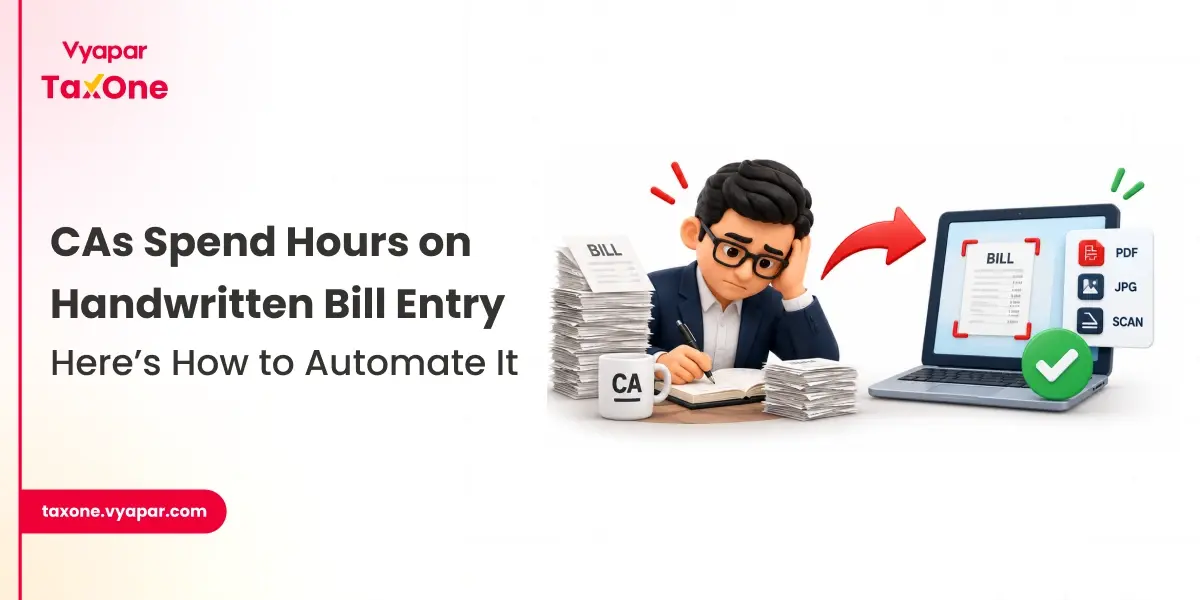
If tax season feels like a constant chase for missing files, delayed replies, and messy email threads, the problem usually is not your team. It is the process.
Many firms still collect tax documents via email, WhatsApp, shared drives, and manual follow-ups. That may work for a handful of clients, but it becomes difficult to manage when deadlines tighten, client volume increases, and every missing file affects review, filing, and reporting timelines.
Automating tax document collection helps you create a structured, repeatable system for requesting, receiving, tracking, and storing client documents. Instead of relying on memory and manual follow-ups, your team can work from a clear workflow with defined deadlines, status tracking, and secure document access.
In this guide, we will explain how automated tax document collection works, which features matter most, and how firms can implement a smoother process without creating extra work for clients.
Manual collection creates friction at every stage of the engagement.
1. Files arrive across too many channels
Clients may send invoices by email, bank statements by WhatsApp, spreadsheets through Drive links, and other records as scanned PDFs. When files are scattered across platforms, your team spends more time locating documents than reviewing them.
2. Follow-ups become repetitive
Without an automated workflow, staff must manually check what is still pending, send reminders, and repeat the same instructions to multiple clients. This consumes time that could be used for review, reconciliation, and advisory work.
3. Missing documents are discovered too late
In manual processes, firms often realize a key document is missing only when preparing the return. That leads to last-minute calls, deadline pressure, and rework.
4. There is limited visibility for the team
When collection depends on individual staff members, the status of each client request is not always visible to the rest of the team. That makes handoffs harder and increases the chance of missed tasks.
5. Security and access control are harder to manage
Sensitive financial and tax records should not be spread across unmanaged folders and message threads. A better process gives firms one controlled place to store and review documents.
Faster turnaround
Automated requests and reminders reduce back-and-forth communication and help firms receive documents earlier in the cycle.
Better document control
A centralized workflow makes it easier to see what has been received, what is pending, and which client needs follow-up.
Fewer manual errors
When files are organized by client, period, and category; teams spend less time renaming, moving, and searching for documents.
Better client experience
Clients prefer a simple process with clear instructions, one upload destination, and fewer repeated reminders.
Easier scaling during peak periods
As the number of clients grows, automation helps maintain consistency without increasing administrative overhead at the same rate.
Not every document tool is built for tax and compliance workflows. If your goal is to automate tax document collection effectively, look for these features.
Centralized client-wise document storage
Store all client files in one place with folders organized by client name, financial year, engagement, or module. This speeds up retrieval and reduces dependence on individual team members.
Easy uploads for clients
The upload process should be simple enough for non-technical users. Support for PDFs, Excel files, images, and bulk uploads is especially useful during busy periods.
Automated requests and reminders
Your team should be able to create document requests with due dates, instructions, and reminders. This removes the need for repeated manual follow-ups.
Real-time status tracking
A good system should show which files are received, pending, overdue, or under review. This visibility helps managers monitor progress without having to chase updates.
Access controls and document security
Tax documents contain highly sensitive data. Access should be role-based so the right people can upload, review, or download files without unnecessarily exposing records.
Integration with tax and accounting workflows
The document process should support the next step in the workflow, whether that is reconciliation, return preparation, audit review, or client communication.
Here is a practical model many firms can follow:
Build a document checklist for each service type, such as GST filing, ITR preparation, TDS work, or audit support.
Share document requests early with a clear due date and simple instructions. Clients are more likely to respond when expectations are specific.
Avoid sending clients across multiple channels. A single, secure location for uploads keeps the process cleaner.
Instead of manual follow-ups, trigger reminder messages for pending submissions before the due date and again if the due date passes.
Your team should be able to view each client’s status without opening multiple messages or folders.
If key documents are still missing, the system should make those gaps visible early so the team can follow up before filing deadlines are at risk.
Vyapar TaxOne’s document management feature is designed for accountants and tax professionals who want to automate tax document collection without the tech headaches:
Clients upload files directly to their designated folders, no more email chaos.
Systematic, module-wise folders for every client and document type.
Instantly see which documents are received, pending, or need follow-up.
Set up frequency and send requests with deadlines; Vyapar TaxOne handles the reminders.
Access, manage, and share documents safely from anywhere, no physical files needed.
| Aspect | Manual Collection | Automated Collection (e.g., Vyapar TaxOne) |
|---|---|---|
| Document Organization | Scattered, hard to track | Centralized, instantly accessible |
| Follow-ups | Manual emails/calls | Automated reminders and tracking |
| Security | Risk of breaches/errors | Encrypted, access-controlled |
| Client Experience | Frustrating, slow | Seamless, user-friendly |
| Time Spent | High | Significantly reduced |
Look for platforms with bank-grade encryption and detailed access controls to keep client data safe.
Automated tracking and reminders keep you informed in real time, so nothing slips through the cracks.
Leading solutions offer seamless integration for faster processing and less manual work.
Automate reminders, simplify uploads, and provide a user-friendly portal to make the process painless for clients.
Manual document collection is quickly becoming obsolete. Today’s tax professionals need to focus on value-added services, not admin work. Here’s why automation is the new standard:
Automating tax document collection isn’t just about saving time; it’s about reducing errors, boosting security, and delivering a better experience for your clients and your team. Make this tax season your smoothest one yet by embracing automation and letting technology do the heavy lifting.
“Vyapar TaxOne has completely transformed how we handle tax filing and its document collection! Automated requests and real-time tracking have saved us countless hours and kept our clients happy.” - Rahul Mehta, Chartered Accountant
Ready to reclaim your time? Start automating your tax document collection today!
Automated tax document collection isn’t just a trend; it’s the future of efficient, secure, and client-friendly tax workflows. Don’t get left behind. Try a solution like Vyapar TaxOne and take the first step toward a smarter, more productive tax season.

Tax Professional & Business Finance Expert

Tax Professional & Business Finance Expert
Tax Professional & Business Finance Expert