 Is Now Vyapar TaxOne | Same Trust, New Name!
 AI Weapon for Financial Soldiers
Vyapar TaxOne


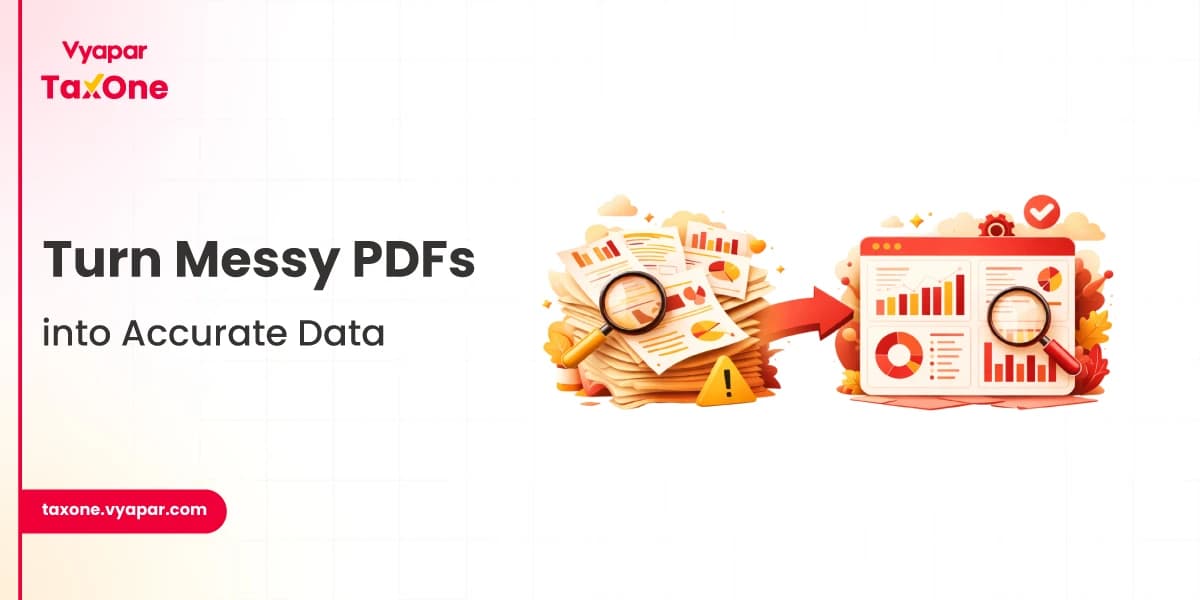
In the world of taxation and accounting, accuracy is non-negotiable, especially when dealing with bank statement data entry.
Tax professionals in India often face the challenge of manually entering transaction data from PDF statements, which can lead to costly errors and inefficiencies.
This blog explores how automation can improve the accuracy of bank statement PDF entries, reducing errors, enhancing compliance, and optimising tax professionals' workflows.
Each bank uses a unique format for presenting bank statement data. These differences can make it challenging to standardise data entry processes. The formats may include:
Manual data entry invites mistakes, such as:
These errors can lead to significant compliance risks, especially when preparing GST, TDS, and other tax returns.
Manual entry of bank statements is time-intensive, reducing efficiency and delaying tax filings. The repetitive nature of this task takes away valuable time that could be better spent on analysis or client advisory.
Automation refers to using technology, particularly OCR (Optical Character Recognition) and AI (Artificial Intelligence), to extract and enter bank statement data into accounting or tax software. Below are the primary components of this process:
Optical Character Recognition (OCR)
OCR scans PDF documents and converts them into machine-readable text. This eliminates manual typing errors and enhances speed.
AI-Powered Intelligent Parsing
AI systems can intelligently parse data from various formats, recognise patterns in transaction descriptions, and map them accurately to predefined fields.
End-to-End Automation
Automation doesn't stop at data extraction. It also automatically validates and categorises data, reducing human oversight and improving accuracy.
With OCR technology, the text in scanned PDF documents is automatically converted into a machine-readable format. This significantly reduces the likelihood of transcription errors.
AI-powered systems can analyse transaction data, recognise transaction types, and automatically assign them to the correct category (e.g., debit, credit, fees, etc.).
Bank Statement Data Extraction vs Manual Entry
| Parameter | Manual Entry | Automated Entry |
|---|---|---|
| Data Extraction Speed | Slow | Fast |
| Error Rate | High | Very Low |
| Time Spent Per Transaction | 2–3 Minutes | Less Than 1 Minute |
| Compliance Check | Manual, Error-Prone | Real-Time Automated Checks |
| Data Mapping | Manual Mapping | AI-driven Categorization |
Automation systems not only extract but also validate data in real-time. If there's an inconsistency (e.g., a mismatch in transaction amounts or an invalid account number), the system can flag it for review.
Whether the bank statement comes in PDF, Excel, or scanned image form, automated tools ensure that data is uniformly processed across all formats.
Automation minimises data entry errors, leading to more reliable GST and TDS filings. This reduces the risk of audits and ensures accurate tax filings.
Automated systems process data faster than manual methods, enabling tax professionals to work on more clients in less time.
By automating repetitive tasks, firms free up resources for higher-value activities.
Automation scales with your business, enabling tax professionals to handle more clients and higher transaction volumes without hiring additional staff.
When choosing an automation solution, consider:
While automation significantly reduces errors, human oversight remains necessary to review flagged exceptions and ensure compliance with Indian tax regulations.
Select tools that integrate smoothly with GST software or Tally to ensure seamless data transfer.
Proper training ensures your staff can leverage the full potential of automation and interpret system outputs accurately.
For tax professionals in India, the shift from manual entry to automated bank statement processing is not just an upgrade; it's a necessary step towards greater accuracy, efficiency, and compliance.
By adopting automation technologies, professionals can significantly reduce transcription errors, speed up data entry, and improve client service.
One standout solution for Indian tax professionals is Vyapar TaxOne's Data Entry Automation. This feature automates the entire process of converting bank statement PDFs to ledgers, ensuring accurate, timely, and compliant data entry.
Key benefits include:
Vyapar TaxOne reduces manual entry errors by up to 80%, enabling tax professionals to focus on higher-value tasks such as client advisory and compliance review.
To learn more about this powerful feature, try it for free!
Automation uses OCR (Optical Character Recognition) and AI to extract, categorise, and validate data from bank statements, significantly reducing human errors and improving data accuracy.
Automation offers faster processing, improved compliance, reduced manual errors, and cost efficiency, allowing tax professionals to focus on higher-value tasks.
Vyapar TaxOne automates PDF-to-ledger conversion, ensuring accurate data entry, real-time error detection, and seamless integration with accounting systems such as Tally.
Yes, automation tools can process various bank statement formats (PDF, Excel, scanned images) and standardise them for accurate data extraction and categorisation.
While automation significantly reduces errors, human oversight is still required to review flagged discrepancies and ensure compliance with tax regulations.


Tax Professional & Business Finance Expert
Tax Professional & Business Finance Expert
Tax Professional & Business Finance Expert