 Is Now Vyapar TaxOne | Same Trust, New Name!
 AI Weapon for Financial Soldiers
CEO


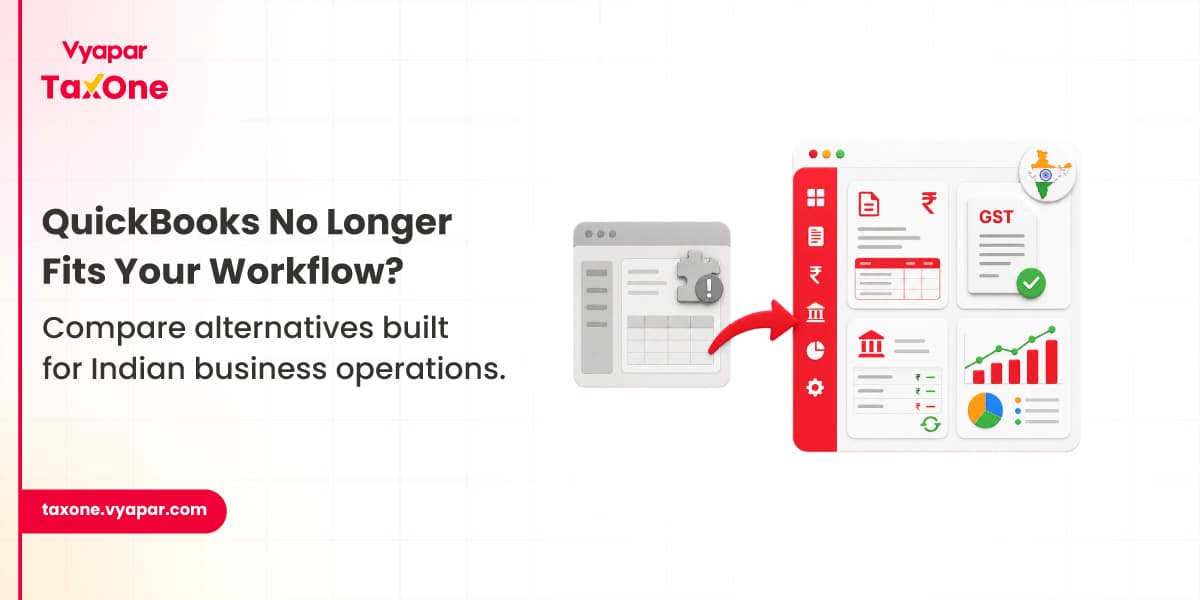
When QuickBooks stopped serving the Indian market, many businesses had to rethink how they managed accounting. For some, the immediate concern was finding software that could replace familiar features. For others, the bigger challenge was ensuring that daily accounting work continued without disrupting billing, GST compliance, inventory tracking, and financial reporting.
We've seen that choosing an accounting platform isn't just about replacing one software with another. It affects how finance teams process transactions, how accountants collaborate with business owners, how GST returns are prepared, and how easily records can be reviewed during audits.
The right QuickBooks alternative should support the way your business actually operates today, not just replicate what QuickBooks used to do.
Many businesses start by comparing pricing or the number of features available. In practice, those aren't usually the deciding factors after a few months of usage.
Accounting teams often evaluate software based on questions like:
These operational considerations become even more important for businesses handling multiple branches, high invoice volumes, or frequent GST reconciliations.
Zoho Books is often shortlisted by businesses looking for cloud-based accounting software with strong GST capabilities. It supports invoicing, expense management, banking integrations, inventory, and financial reporting from a single platform.
For businesses already working within the Zoho ecosystem, it also integrates well with other business applications.
Best suited for:
Operational strengths
One point worth considering is that businesses with highly customized accounting processes may require additional setup to match existing workflows.
Vyapar has become a preferred option for many Indian retailers, wholesalers, manufacturers, distributors, and service providers looking for accounting software designed specifically around Indian business requirements.
Instead of focusing only on bookkeeping, it combines accounting, billing, inventory, GST compliance, receivables, and business reporting in one application.
Best suited for:
Operational strengths
For businesses managing day-to-day operations internally, having accounting and inventory connected reduces the need to maintain separate records across multiple systems.
HostBooks focuses heavily on compliance-oriented accounting workflows. Businesses handling regular tax filings, reconciliations, and statutory reporting often consider it when evaluating QuickBooks alternatives.
Its accounting platform combines bookkeeping with GST and tax compliance features, making it useful for organizations where accounting and compliance teams work closely together.
Operational strengths
Businesses should still evaluate whether its workflow aligns with their internal accounting process, especially if multiple departments are involved in approvals.
For many Indian businesses, TallyPrime continues to be one of the most widely used accounting systems. Its familiarity, extensive accountant ecosystem, and strong reporting capabilities make it a common destination for businesses moving away from QuickBooks.
It is particularly suitable for organizations processing large transaction volumes where structured accounting records are essential.
Operational strengths
Many CA firms already work with Tally data during audits, tax filings, and financial reviews, which reduces onboarding effort when collaborating with clients.
Businesses evaluating multiple accounting platforms often compare how different solutions handle GST compliance, reporting, inventory, and collaboration before making a final decision.
Looking at these operational differences side by side usually makes the selection process much easier.
The software itself is rarely the biggest challenge.
What usually creates delays is everything surrounding the migration.
We've often seen businesses underestimate the amount of preparation required before moving from one accounting system to another. Customer masters, supplier records, opening balances, GST classifications, inventory items, and historical transactions all need to be reviewed before importing them into a new system.
Even small inconsistencies can create additional work later during reconciliation or financial reporting.
In many finance teams, migration also involves coordination between accountants, business owners, external CAs, and operational staff. If everyone is working from different spreadsheets or outdated exports, discrepancies become difficult to trace.
This is where accounting teams usually spend the most time.
Common issues include:
Many of these issues actually begin before data reaches the accounting software. When invoice preparation, validation, and accounting happen across disconnected files, inconsistencies become much harder to identify during migration. This is one reason many businesses are also re-evaluating the role of pre-accounting software alongside their accounting platform.
Most of these issues don't appear immediately. They typically become visible during bank reconciliation, GST return preparation, or financial statement review when teams begin validating reports against previous accounting periods.
The impact of changing accounting software usually isn't visible on the first day. Most issues surface during routine accounting activities when teams begin validating data for GST filing, month-end closing, or management reporting.
A trading business with close to 4,000 invoices migrated from QuickBooks to a new accounting platform before the financial year-end. The migration itself appeared successful, but while preparing GSTR-1 and reconciling customer ledgers, the finance team found that several ledger names had been mapped differently from the original records.
The discrepancies weren't significant individually, but correcting them required reviewing historical transactions over several days, delaying month-end reporting and creating additional review work for both the internal accountant and the external CA.
We've also seen this happen in businesses operating from multiple locations. Sales teams continue maintaining customer information in spreadsheets while accountants begin recording transactions in the new accounting software.
By the time reconciliation starts, more than 300 invoices may require manual verification because customer names, GSTINs, or item classifications differ between the spreadsheet and the accounting system. The issue isn't the software itself, it's the absence of a structured process for validating data before and after migration.
From working with accounting teams, a few patterns appear repeatedly during software transitions:
The software selection is important, but the migration process and post-migration review often determine whether the transition is successful.
Before finalizing any accounting software, many businesses follow a structured evaluation process instead of comparing feature lists alone.
Step 1: Review current workflows
List the accounting activities your team performs every month, billing, purchases, inventory updates, GST reporting, banking, and financial reporting.
Step 2: Identify dependencies
Understand how your accountant, CA firm, branch offices, or finance team currently exchange information. These dependencies often influence software suitability more than individual features.
Step 3: Validate migration readiness
Review customer masters, supplier records, GST classifications, inventory items, and opening balances before transferring data into the new system.
Step 4: Test reporting accuracy
Generate key reports such as Trial Balance, Profit & Loss, Balance Sheet, GST reports, and outstanding receivables before completely moving away from the previous software.
Step 5: Standardize data management
Establish clear ownership for creating ledgers, updating master records, and importing transactions so duplicate records don't accumulate over time.
Use this checklist during your evaluation:
Choosing a QuickBooks alternative isn't just about replacing one accounting software with another. The bigger challenge is ensuring your accounting workflows continue smoothly as your business grows.
In many businesses, migration issues don't stem from missing features. They arise because customer and vendor masters, GST classifications, inventory records, and historical transactions aren't reviewed thoroughly before the transition. These gaps often become visible only during GST reconciliation, month-end closing, or audit preparation, when correcting them requires additional time and coordination.
We've also seen that as transaction volumes increase, relying on disconnected spreadsheets, manual imports, and multiple data sources becomes difficult to manage consistently. This is why many accounting teams gradually move toward more structured workflows that improve data validation, reconciliation, and collaboration across finance teams and CA firms.
This is the kind of operational challenge that structured systems like Vyapar TaxOne are built to address in accounting environments. Rather than replacing your accounting software, they help organize the movement of accounting data, reduce manual intervention in repetitive processes, and make reconciliation workflows easier to manage as operational complexity increases.
It depends on reporting requirements, audit needs, and the volume of historical transactions. Many businesses retain historical records separately while migrating essential accounting data into the new system.
Reviewing master data, validating GST classifications, checking opening balances, and testing reports before going live significantly reduces reconciliation effort later.
They often result from inconsistent naming conventions, multiple imports, or different users creating records independently during the transition.
Not necessarily. The software should support your accounting workflow, reporting requirements, GST compliance, and future transaction volume rather than simply offering the lowest price.
Ideally before migration begins. Early involvement helps ensure reporting structures, compliance requirements, and accounting workflows remain consistent after the switch.

Tax Professional & Business Finance Expert
Tax Professional & Business Finance Expert
Tax Professional & Business Finance Expert