 Is Now Vyapar TaxOne | Same Trust, New Name!
 AI Weapon for Financial Soldiers
Vyapar TaxOne


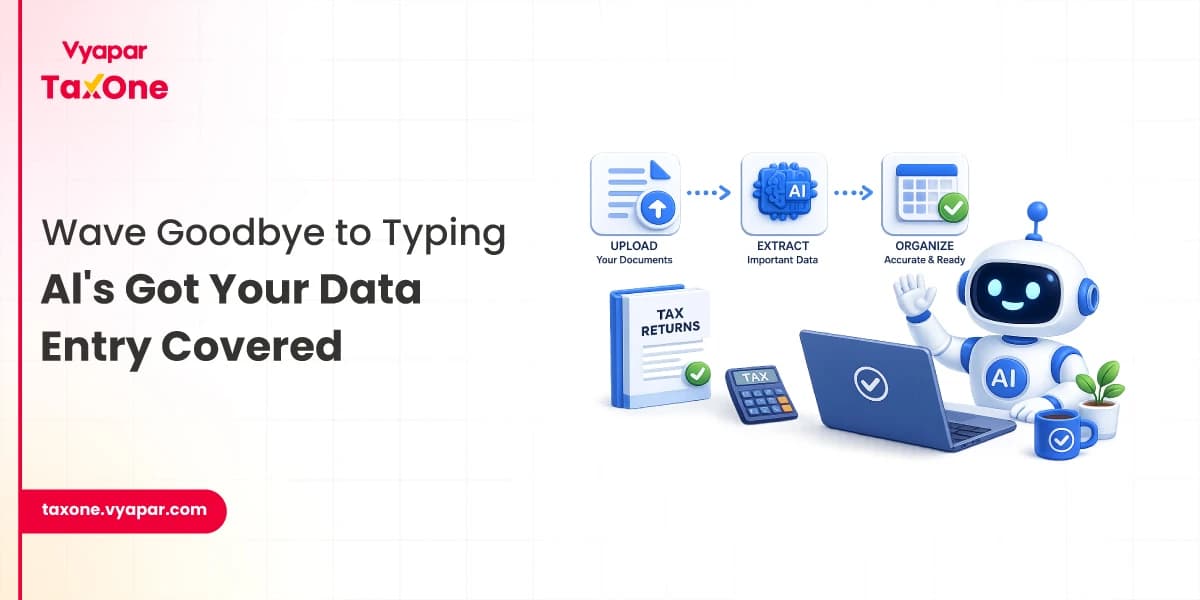
AI data entry is now widely discussed, but for accounting teams, the real question is not just what AI can do. It is how well it handles invoices, receipts, PDFs, Excel sheets, bank statements, GST details, and ledger data in daily accounting work.
At Vyapar TaxOne, we understand these practical challenges because our focus is on simplifying real accounting workflows for businesses and tax professionals.
That is why this blog explains AI data entry from a practical accounting perspective, showing how it saves time, reduces manual errors, and helps teams manage financial data more efficiently.
AI data entry automation is the process of using artificial intelligence to capture, read, validate, and enter information from documents into digital systems.
Instead of manually entering details from invoices, receipts, PDFs, Excel files, bank statements, and vouchers, AI-powered tools identify the required fields and format the information accordingly.
For accounting teams, this usually includes details such as:
Traditional data entry depends heavily on manual effort. AI data entry reduces that dependency by automating repetitive tasks while allowing users to review, verify, and approve important financial information before final posting.
This makes the process faster, more consistent, and easier to scale as document volume increases.
AI automates data entry by combining document reading, pattern recognition, and workflow automation. In accounting, the process usually works in the following way:
The user uploads files such as invoices, receipts, PDFs, Excel sheets, bank statements, or purchase and sales documents.
The AI reads the document and extracts important information using OCR and machine learning. This data extraction process helps identify fields such as date, amount, vendor name, invoice number, GST details, and other accounting data more quickly, reducing manual effort and entry errors.
After extraction, the system categorises the information. For example, it can separate purchase invoices from sales invoices or identify whether a transaction belongs to a specific expense category.
AI data entry tools can highlight mismatches, missing fields, duplicate entries, or unusual values. This helps users review issues before the data moves into the accounting system.
Once the data is checked, it can be pushed into accounting software such as Tally or Vyapar without manually copying and pasting every field.
This workflow helps reduce repetitive work and allows accounting professionals to spend more time on review, reconciliation, compliance, and advisory tasks.
AI’s influence on data entry cannot be overstated. The impact is far-reaching, affecting businesses in various industries, especially those that deal with large amounts of data, such as accounting, healthcare, and logistics.
These benefits highlight why more businesses are adopting data entry AI solutions to streamline their operations.
Accounting data needs more than speed. It needs accuracy, consistency, and proper classification. Even a small manual error in invoice details, GST values, ledger mapping, or bank entries can affect reporting and reconciliation.
AI data entry helps accounting teams by reducing repetitive typing and improving the quality of financial records.
For CA firms, bookkeepers, and finance teams, this can be useful during:
The biggest advantage is not just automation. It is the ability to process data faster while maintaining human review for accuracy and compliance.
One company at the forefront of leveraging data entry AI is Vyapar TaxOne. Vyapar TaxOne provides comprehensive accounting automation solutions that help businesses manage their finances more efficiently.
The platform uses AI-powered data entry automation to process bank statements, PDFs, Sales/Purchase Excels, invoices, receipts, vouchers, and other financial documents, saving businesses valuable time and reducing human error.
Vyapar TaxOne’s accounting automation is centered around its data entry AI capabilities, which include the following:
Vyapar TaxOne’s data entry AI is designed to handle various types of financial data, from invoices to receipts, and ensures that the data is processed quickly and accurately.
With this automation, businesses can focus on strategic financial planning rather than getting bogged down in tedious data entry tasks.
Automatic Data Extraction and Categorization:
Vyapar TaxOne’s data entry AI automates extracting key data from financial documents. The AI scans documents using OCR technology, extracts the necessary details, and categorizes the data accordingly. For example, it can extract the total amount from an invoice, map it with Tally ledgers, and then send it to Tally.
Real-Time Processing:
AI ensures data is processed in real-time, providing businesses with up-to-date financial information. This feature allows companies to track expenses, revenue, and other financial metrics without delay.
Integration with Accounting Systems:
Vyapar TaxOne’s data entry automation integrates with popular accounting systems like Tally and Vyapar. This integration eliminates the need for manual data transfer, reducing the chances of errors and saving time.
Scalable and Customizable:
Vyapar TaxOne’s data entry AI solution can scale with your needs, whether you’re a small business or a large enterprise. It can handle a high volume of invoices, receipts, and financial documents, all while maintaining the same level of accuracy and efficiency.
AI data entry is most useful for repetitive, document-heavy, time-sensitive accounting tasks.
Invoice Processing: AI can extract invoice numbers, vendor names, dates, GST values, taxable amounts, and total amounts from invoices. This saves time during purchase and sales entry.
Bank Statement Entry: Bank statements often contain many transactions. AI can help read, categorise, and prepare transaction data for accounting systems.
PDF to Accounting Entry: Many businesses receive financial data in PDF format, such as invoices, receipts, and bank statements. AI data entry helps convert this PDF data into structured accounting entries. With PDF to Tally automation, the extracted data can be imported into Tally more quickly, reducing manual typing and errors.
Sales and Purchase Excel Processing: Accounting teams often receive sales and purchase data in Excel files. AI-powered automation can help clean, classify, and move that data into the required accounting workflow.
Receipt and Voucher Entry: Receipts and vouchers are easy to misplace or enter incorrectly. AI can extract details from these documents and make them easier to organise.
GST-Related Data Preparation: Accurate data entry is important for GST reconciliation and filing. AI data entry helps reduce manual mistakes before the data reaches the reconciliation stage.
The future of data entry AI looks promising. As AI technology continues to evolve, its capabilities will only expand. Some of the future trends in data entry AI include:
The continuous development of data entry AI will allow businesses to reduce costs, improve data accuracy, and enhance decision-making capabilities.
Adopting AI-driven accounting automation solutions like Vyapar TaxOne’s can offer significant advantages for businesses.
Here’s a quick comparison of traditional data entry vs. AI data entry:
| Feature | Traditional Data Entry | AI Data Entry |
|---|---|---|
| Speed | Slow and manual | Faster document processing |
| Accuracy | Depends on manual typing | Reduces common entry errors |
| Cost | Higher manual effort | Saves operational time |
| Scalability | Difficult during high-volume work | Handles larger document volumes |
| Review Process | Manual checking required | AI can flag missing or unusual data |
| Integration | Requires copy-paste or manual upload | Can connect with accounting systems |
| Best Use | Small, occasional data tasks | Repetitive accounting and document-heavy workflows |
As shown in the table, AI-powered data entry saves time and money and ensures higher accuracy and scalability.
AI is transforming the way businesses handle data entry. Through data entry AI, companies can automate time-consuming tasks, reduce human errors, and gain real-time insights into their operations.
Vyapar TaxOne’s accounting automation is a perfect example of how AI in data entry can revolutionize financial processes, making them faster, more accurate, and cost-effective.
As businesses seek ways to optimize operations, adopting AI-powered solutions like Vyapar TaxOne’s data entry automation is essential to improving efficiency and reducing operational costs.
To streamline your accounting and data entry processes, consider exploring Vyapar TaxOne’s AI-powered accounting automation for a more intelligent, more efficient approach.
AI data entry is the use of artificial intelligence to read, extract, classify, and enter information from documents into digital systems. In accounting, it is commonly used for invoices, receipts, bank statements, PDFs, Excel files, and vouchers.
AI helps by reducing manual typing. It can identify key fields, extract values, categorise information, flag potential errors, and transfer data to accounting software for review and approval.
Yes. AI data entry is especially useful for accounting because financial documents often contain repetitive information such as invoice numbers, dates, GST details, vendor names, amounts, and ledger data.
No. AI data entry helps automate repetitive work, but accountants are still needed for review, compliance, reconciliation, decision-making, and final approval.
AI data entry tools can process documents such as invoices, receipts, bank statements, purchase and sales Excel files, vouchers, PDFs, and other structured or semi-structured financial records.


Tax Professional & Business Finance Expert
Tax Professional & Business Finance Expert
Tax Professional & Business Finance Expert