 Is Now Vyapar TaxOne | Same Trust, New Name!
 AI Weapon for Financial Soldiers
CEO


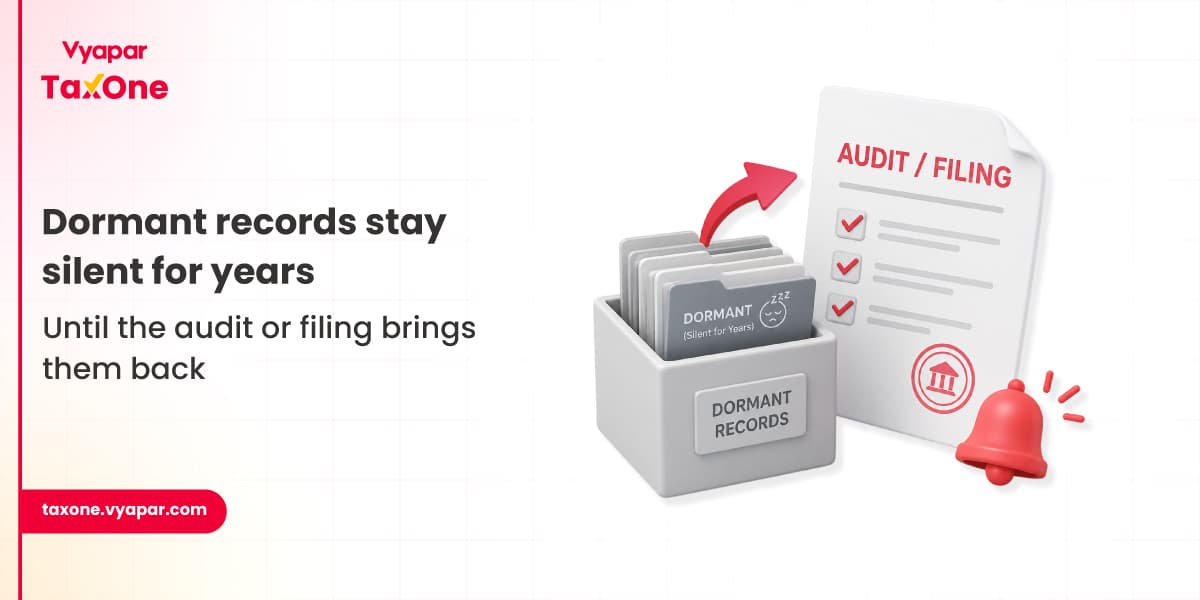
Inside most CA firms and finance teams, dormant companies and inactive bank accounts are often treated as records that no longer need active attention.
But operationally, that assumption creates problems.
Even when a company stops business activity or a bank account stops being used, both records continue to exist across multiple systems, such as:
So while business activity stops, the compliance footprint remains active.
And that is where dormant records quietly begin creating future workload.
The issue usually stays invisible until audit preparation, statutory review, bank verification, or restructuring activity forces teams to revisit records that nobody has monitored for months or sometimes years.
One mistake teams commonly make is treating dormant records as “inactive records.”
In reality, dormancy is simply another stage in the accounting lifecycle.
It usually progresses like this:
Stage 1: Business activity stops
Stage 2: Teams stop monitoring the record
Stage 3: ERP or compliance systems retain outdated data
Stage 4: Filing or reconciliation systems become inconsistent
Stage 5: Audit or compliance review discovers the mismatch
Stage 6: Teams do urgent correction work under deadlines
So the real issue is rarely dormancy itself.
The real issue is that no structured process exists for managing records once operational activity stops.
On paper, dormant companies may appear simple.
No revenue.
No transactions.
No active operations.
But inside accounting and compliance workflows, these entities often continue behaving like live compliance objects.
Teams may still need to manage:
This creates friction when different systems begin showing conflicting information.
For example:
The problem may remain hidden for months.
But during audit cycles, these mismatches become visible immediately.
Dormant bank accounts rarely create day-to-day bookkeeping issues.
The problem appears later.
This is what usually happens.
A bank account gets created for:
Once usage stops:
Months later, during reconciliation or audit preparation, the account becomes relevant again.
This is where delays begin. Teams often face:
The dormancy itself is not the problem.
The real issue is incomplete account closure inside accounting systems, which often creates reconciliation gaps in accounting workflows when inactive accounts continue to remain connected to historical financial records.
Most dormant-related problems are not caused by negligence.
They usually develop because accounting systems are designed around active transactions, not inactive records.
Common workflow gaps include:
As a result, dormant records slowly accumulate unnoticed. In many firms, these process weaknesses become more visible when teams continue depending on manual systems, which is a common challenge seen in accounting automation risk in compliance workflows.
This is the stage where dormant records stop being administrative records and start affecting operational timelines.
In practice, CA teams usually encounter:
These issues rarely surface one by one. In many cases, these operational failures closely resemble common accounting errors in reconciliation and reporting cycles, especially when inactive records remain unreviewed for long periods.
Not all dormant records create the same level of risk.
CA firms should classify dormant records based on severity.
Low Risk
Minor operational inactivity.
Examples:
These mainly create reporting clutter.
Medium Risk
Records capable of affecting reconciliation.
Examples:
These create reconciliation delays.
High Risk
Dormant records capable of affecting compliance or audit outcomes.
Examples:
These create compliance exposure and audit pressure.
In one multi-entity accounting setup, nearly 12 companies were marked internally as inactive.
During audit preparation, teams discovered that several entities still required updated compliance validation because historical records across systems were inconsistent.
Instead of handling corrections gradually during the year, the entire correction process had to happen during audit deadlines.
A similar pattern happens with dormant bank accounts.
In one reconciliation cycle, old reimbursement accounts that had not been used for over a year remained mapped inside ERP systems.
Two accounts required bank-level reactivation and statement retrieval before reconciliation could be completed.
Month-end closure was delayed because dormant accounts were never reviewed proactively.
This pattern is more common than most firms expect.
One major reason dormant records get ignored is ownership confusion.
Nobody clearly knows who is responsible.
A structured workflow generally looks like this.
Responsible for:
Responsible for:
Responsible for:
Responsible for:
Without ownership clarity, dormant records stay unreviewed indefinitely.
In most firms, dormant record management is still highly reactive.
The workflow usually looks like this:
The problem is not effort.
The problem is a lack of process design.
Instead of reviewing dormant records only during audits, firms should create a structured dormant control process.
This prevents year-end workload spikes.
In many accounting setups, dormant records are not actively monitored because teams naturally prioritize active entities, ongoing transactions, and current filing obligations.
The problem is that inactive records rarely disappear from accounting systems completely.
A dormant company may remain connected to compliance calendars, filing history, and statutory records. An inactive bank account may continue to exist inside ERP master data, historical ledger mapping, or reconciliation structures even when operational activity has already stopped.
This usually becomes difficult when tracking remains manual.
In practice, many finance teams still depend on:
On a smaller scale, these gaps often remain unnoticed.
But as the number of entities, bank accounts, vendors, and reporting cycles increases, dormant records begin accumulating without structured review.
The real workload appears later.
During audit preparation, statutory filing checks, reconciliation reviews, or banking verification cycles, inactive records suddenly require immediate attention.
Teams then end up dealing with:
The operational issue is rarely dormancy itself.
It is the absence of a structured process that continuously tracks inactive records before they silently become compliance work later.
This is exactly why many accounting teams gradually move toward more centralized systems where active and inactive records are managed within the same operational workflow instead of being tracked separately through spreadsheets and disconnected compliance files.
In many firms, solutions like Vyapar TaxOne become part of that transition as teams look for better visibility across compliance records, reconciliation workflows, and long-term accounting control.
They usually do not appear suddenly. They surface because internal records, compliance trackers, and statutory filing history stop remaining aligned over time.
Because account activity stops operationally, but system mappings continue to exist inside ERP and historical ledgers.
Usually, during audit review, banking verification, statutory filing validation, or entity restructuring.
Most ERP systems do not automatically classify inactive records unless firms create structured review workflows.
Supporting documentation, approval history, and account validation are often not maintained during the inactive period.
At a minimum, during monthly monitoring, quarterly review cycles, and year-end audit preparation.
Waiting until audit season usually creates unnecessary correction workload.

Tax Professional & Business Finance Expert

Tax Professional & Business Finance Expert
Tax Professional & Business Finance Expert