 Is Now Vyapar TaxOne | Same Trust, New Name!
 AI Weapon for Financial Soldiers
Vyapar TaxOne


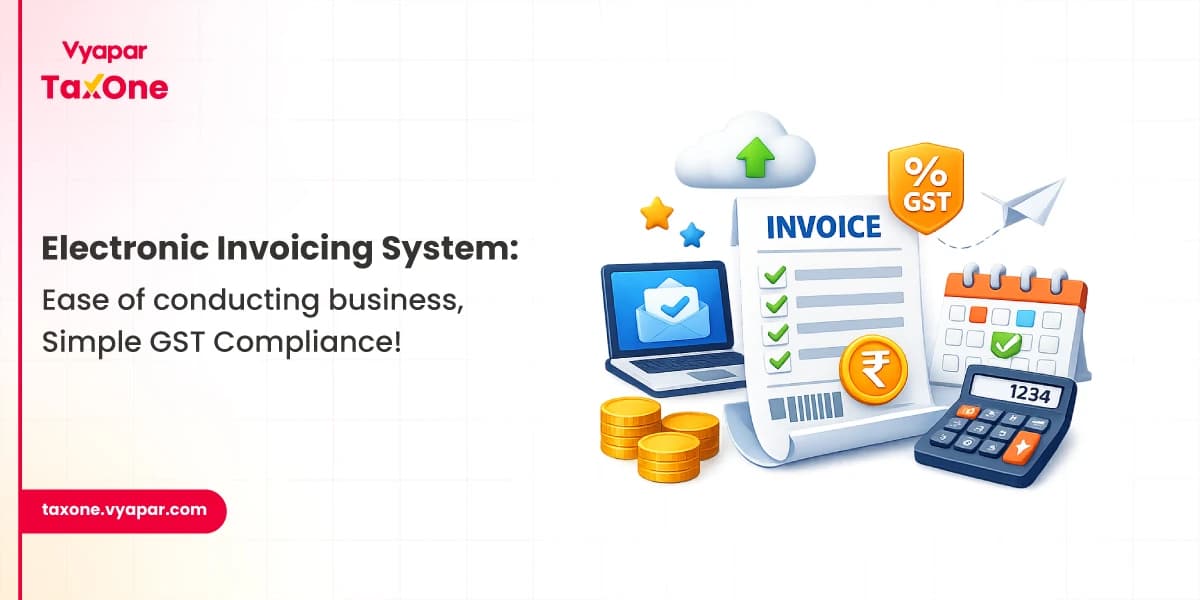
If you're running a business in India, you've already heard about e-invoicing under GST. But for many businesses, the confusion isn't about what e-invoicing is; it's about whether it applies to them, how to comply, and what happens if they don't.
At its core, e-invoicing is not about creating invoices on a government portal. Instead, it is a validation system.
You generate invoices using your usual accounting or billing software. These invoices are then reported to the Invoice Registration Portal (IRP), which validates them and assigns a unique Invoice Reference Number (IRN) along with a QR code.
This system was introduced to:
But over time, e-invoicing has evolved, and recent updates (especially the 30-day rule) have made compliance more critical than ever.
Before diving deeper, it's important to understand the current rules.
Here's a quick snapshot:
| Rule | Current Status |
|---|---|
| E-invoice threshold | ₹5 crore turnover |
| Turnover calculation | PAN-based (all GSTINs combined) |
| 30-day reporting rule | Applies to ₹10 crore+ businesses |
| Applicability | B2B, export, credit/debit notes |
The most important change is the 30-day reporting requirement, which has shifted e-invoicing from "operational task" to "time-sensitive compliance requirement."
The applicability of e-invoicing depends on your aggregate annual turnover (AATO).
If your business crosses ₹5 crore turnover in any financial year, you are required to comply with e-invoicing.
What many businesses miss is this:
Turnover is calculated at the PAN level, not the GSTIN level.
Let's say you operate in multiple states:
Total turnover = ₹5.5 crore
Even though no single GSTIN crosses ₹5 crore, your combined turnover does, so e-invoicing becomes mandatory.
One of the most important updates in recent years is the introduction of the 30-day reporting rule.
Who does it apply to?
What does it mean?
You must upload invoice details to the IRP within 30 days of the invoice date.
What happens if you don't?
This is where things get serious:
In simple terms, late reporting is no longer just a delay; it can break your entire compliance chain.
E-invoicing is not required for every type of invoice. It primarily applies to:
What about B2C invoices?
B2C invoices are not part of the standard e-invoicing system, although QR code requirements may still apply separately.
Not all businesses are required to follow e-invoicing rules, even if they meet turnover criteria.
Common exemptions include:
These exemptions exist due to the nature of their operations and invoicing systems.
Understanding the workflow makes compliance much easier.
Step 1: Invoice Creation
You generate an invoice in your ERP or billing software.
Step 2: Data Conversion
Invoice data is converted into a standard GST format (JSON).
Step 3: Upload to IRP
The invoice is uploaded through:
Step 4: Validation
The IRP checks for:
Step 5: IRN Generation
If valid:
Step 6: Data Sync
The validated invoice is shared with:
For successful validation, certain fields are essential.
Some of the most important ones include:
Even small errors in these fields can lead to rejection by the IRP.
Despite automation, many businesses still face issues with e-invoicing.
Typical mistakes:
How to avoid them:
Instead of relying on manual processes, businesses should:
A small process improvement here can save hours of rework later.
E-invoicing is not optional once applicable.
Non-compliance can lead to:
For businesses dealing with large volumes, even a small lapse can create cascading issues across finance and compliance teams.
While e-invoicing may feel like a compliance burden initially, it actually brings several operational advantages.
Key benefits include:
Over time, businesses that adopt automation see significant efficiency gains.
E-invoicing under GST is no longer just a regulatory requirement; it's becoming a core part of how businesses manage compliance, reporting, and financial workflows.
With stricter timelines like the 30-day rule and increased system integration, the margin for error is shrinking.
The businesses that will stay ahead are not just the ones that comply, but the ones that automate, streamline, and integrate e-invoicing into their daily operations.
No, currently it applies only to businesses crossing ₹5 crore turnover.
No, it primarily applies to B2B transactions.
No, for businesses under the 30-day rule, IRP will reject late invoices.
No, it is calculated at the PAN level.
No, invoices are created in your own system and validated through IRP.

Tax Professional & Business Finance Expert
Tax Professional & Business Finance Expert
Tax Professional & Business Finance Expert