 Is Now Vyapar TaxOne | Same Trust, New Name!
 AI Weapon for Financial Soldiers
Vyapar TaxOne


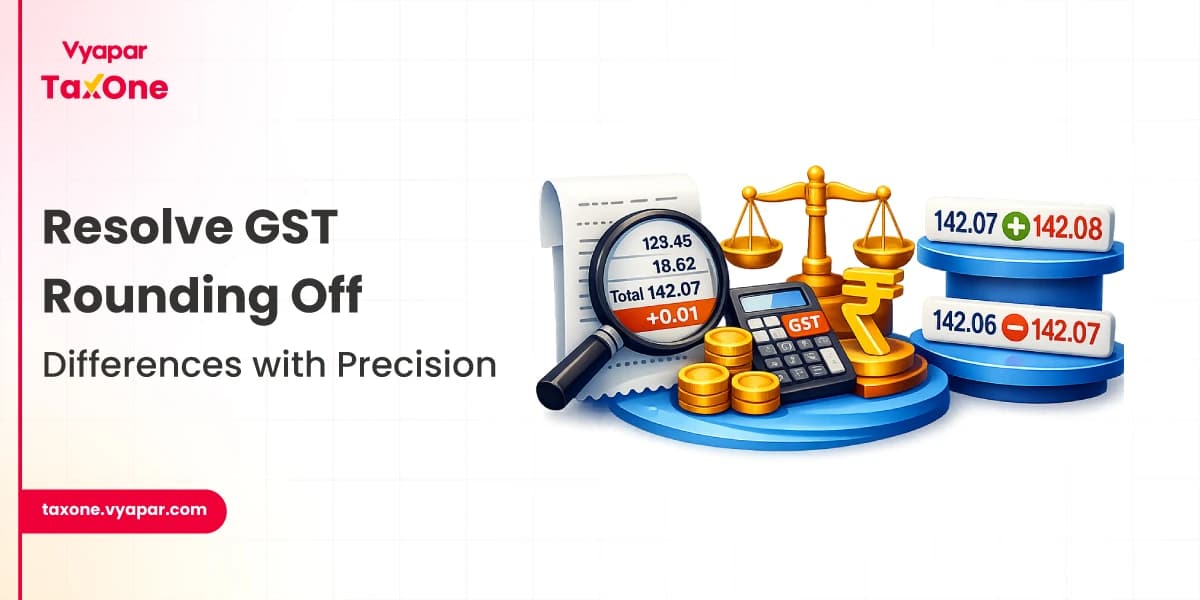
GST rounding difference for reconciliation is a critical skill for tax professionals in India, managing high-volume transactions.
With 2026's intensified GST portal validations, mandatory e-invoicing expansions, and automated compliance checks, addressing paisa mismatch adjustments and minor variance resolution has never been more urgent to prevent ITC reversals, audit notices, and penalties.
Section 170 of the CGST Act governs rounding off tax under GST, stipulating normal rounding for all liabilities and inputs. Specifically:
This rule applies individually to CGST, SGST/UTGST, and IGST on each invoice or debit/credit note, not to consolidated totals. For example, a CGST of ₹100.60 rounds to ₹101, while ₹100.40 becomes ₹100, creating inherent decimal differences that accumulate in bulk scenarios.
Tax professionals often overlook that rounding occurs at the invoice level, not aggregate summaries. In e-invoicing (now mandatory for businesses with AATO > ₹5 crore), the Invoice Registration Portal (IRP) enforces this automatically.
Failure to align books with rounded IRN values leads to discrepancies in GSTR-1 uploads, complicating downstream reconciliation of GST rounding differences.
This precision ensures transparency but demands rigorous decimal difference fixes during monthly returns, especially as 2026 portals reject unrounded mismatches.
High-volume taxpayers face amplified rounding error handling issues due to:
These pain points erode cash flows and client trust, making minor variance resolution a top priority for professionals.
Follow this comprehensive, actionable workflow to master rounding difference reconciliation efficiently.
Start with raw reports to build a solid foundation:
Pro Tip: Use date filters for the reconciliation period (e.g., Jan 2026) to isolate bulk data.
Recreate official rounding to pinpoint paisa mismatch adjustments:
This reveals whether the total rounded liability exceeds the unrounded liability by ₹200, signaling that an adjustment is needed.
File amended GSTR-1 before GSTR-3B; track via GST portal dashboard.
Perform monthly to pre-empt FY-end rushes.
Choose the right tool based on scale for optimal decimal difference fixes:
| Method/Tool | Best For | Strengths | Limitations | Time Savings |
|---|---|---|---|---|
| Excel Formulas | Small firms (<1,000 invoices) | Free; Custom ROUND logic | Manual; Error-prone for bulk | 50% |
| Power BI Dashboards | Mid-size (1K–10K invoices) | Visual variance reports; Auto-refresh | Learning curve | 70% |
| Python/Pandas Scripts | Large enterprises (>10K) | Bulk summation; Export to CSV | Coding required | 85% |
| GST Software (e.g., ClearTax, BUSY) | All scales | Auto-matching; IRP integration | Subscription cost | 90% |
Elevate your practice with these expert strategies for minor variance resolution:
Invoice Template Standardization:
Benefits:
Supplier Ecosystem Management:
Automation Workflows:
Training and Policy:
Monitor CBIC circulars quarterly, recent 2026 amendments clarify immaterial differences.
From January 2026, GSTN introduces:
Proactive GST rounding difference reconciliation isn't optional, it's a safeguard for cash flows, reputations, and penalty-free operations. Tax professionals adopting these methods report 80% fewer notices.
For a turnkey solution to GST rounding difference reconciliation, Vyapar TaxOne stands out. Its GST reconciliation feature automates:
Tailored for Indian tax pros, Vyapar TaxOne slashes reconciliation time from days to hours, integrating seamlessly with e-invoicing. Upgrade your workflow today for stress-free compliance.
Rounding under Section 170 applies per invoice (50 paise up, below down), creating cumulative paisa mismatches between GSTR-1, GSTR-2B, and GSTR-3B totals in high-volume scenarios.
Recalculate taxes with Excel ROUND formulas, aggregate variances, and adjust immaterial differences (<₹1 per invoice) internally or via supplier amendments before filing.
Yes, January 2026 updates enforce auto-populated GSTR-3B with rounded figures, blocking ITC for mismatches and triggering notices for unresolved decimal differences.
Excel or Power BI for small datasets, Python for bulk processing, and GST software like Vyapar TaxOne for automated matching and IRP integration across returns.
Typically no if documented (less than ₹100 net), but in 2026 scrutiny increased; always maintain detailed workings and reconcile monthly to avoid audit escalations.


Tax Professional & Business Finance Expert
Tax Professional & Business Finance Expert
Tax Professional & Business Finance Expert