 Is Now Vyapar TaxOne | Same Trust, New Name!
 AI Weapon for Financial Soldiers
Vyapar TaxOne


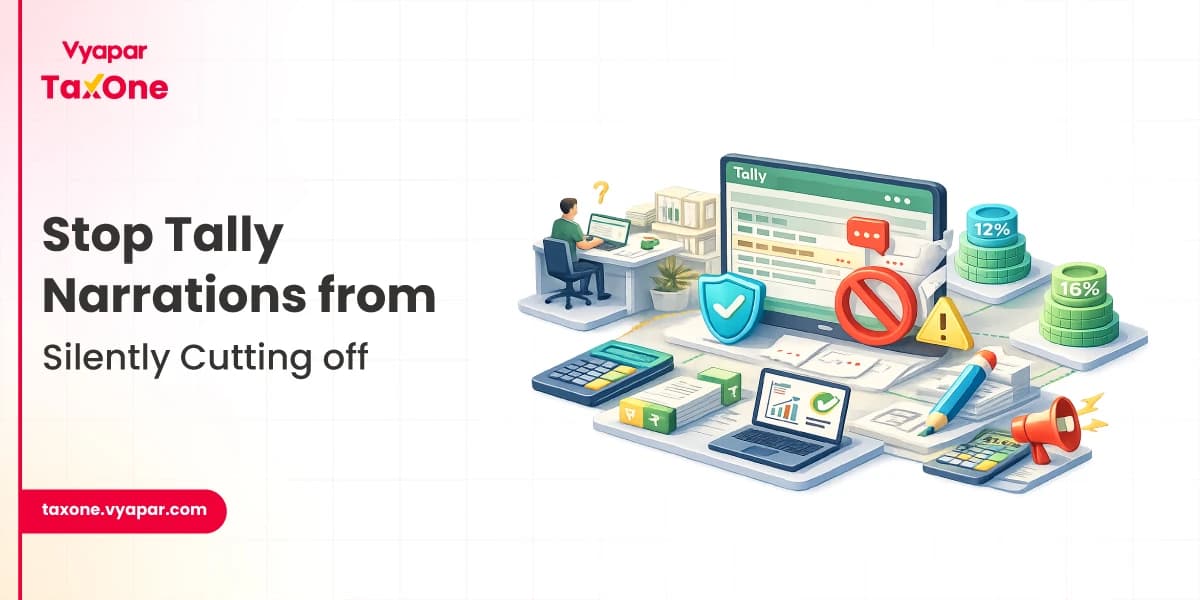
Tally narration truncation has become a serious risk area for tax professionals in India in 2026, especially where Tally is the primary system for GST, TDS, MSME, and audit documentation.
Addressing this issue systematically helps prevent data loss, assessment disputes, and unnecessary reconciliation work.
In most Indian businesses, Tally (TallyPrime or older versions) is the core financial system used to support GST returns, TDS compliance, income tax filings, and audits. Narrations provide critical context, including invoice numbers, UTR references, GSTIN/PAN, contract details, and statutory sections.
When Tally narration truncation or bank description cutoff happens, part of this context silently disappears. This directly affects:
For tax professionals, treating narration quality as a compliance control, not just a bookkeeping detail, is now essential.
Tally offers multiple places to store narration-type information:
In many setups, a practical limit of a few hundred characters applies to each field. Once this Tally character limit is reached, additional text may be:
Bank description cutoff typically occurs when long bank or gateway descriptions are imported directly into a single narration field without any pre-processing or structuring.
The Tally narration truncation problem usually has more than one cause:
Product-level limits The software has hard-coded limits on the size of the narration field; any text beyond these limits is truncated.
Misconfiguration of voucher types If "Provide narration" or "Narration for each ledger" is disabled, users tend to pack all details into one field, quickly hitting the narration field limit.
Custom TDLs and print formats Some older customisations limit the length or visible area of narration fields, resulting in apparent truncation on screens or reports even when more text exists.
Unstructured copy‑paste Long bank narratives, payment gateway descriptions, or e‑commerce references pasted directly into Tally result in uncontrolled length and frequent cutoffs.
Understanding which of these is dominant in your environment helps you choose the right fix.
A focused diagnosis can usually be done in a day:
1. Replicate the issue
2. Check where truncation occurs
3. Review voucher type settings
4. Test with customisations disabled
This simple process tells you whether the main problem is product limits, configuration, or customisation.
Many Tally narration truncation issues can be reduced significantly by careful configuration rather than immediate customisation.
Spreading information across fields reduces the chance of hitting the narration character limit in any single field.
Sometimes the data is stored but not fully visible in reports:
After these changes, re-test sample vouchers and verify that auditors and tax teams can see the full narration in printed and exported formats.
If your firm routinely needs longer narrations, even after optimising structure and configuration; carefully selected add‑ons can extend narration field limits and better handle imports.
When evaluating solutions to the Tally character limit and narration field limit:
Look specifically for features that mention:
Before deployment:
After deployment, monitor performance and confirm that new limits are sufficient but not overly restrictive, discouraging unnecessarily long, unstructured narrations.
Even with more room, the goal is not to create a paragraph in every narration field. Well-structured, concise narrations are easier for both humans and AI tools to read, search, and interpret.
A simple structure that works well for most payments:
This covers audit and compliance requirements while keeping within a reasonable narration length.
For GST-related entries, ensure narrations capture:
The idea is that even if some detail is truncated, the core tax character of the transaction remains clear.
Maintain a small internal library of narration templates for:
Standard text can then be adapted instead of composed from scratch, reducing both truncation risk and inconsistency.
Bank description cutoffs often appear when bank statements or gateway settlements are imported directly into Tally, resulting in long, cryptic descriptions.
Before import:
The goal is to import full descriptions in meaning, not necessarily every character.
For high-volume environments, consider automated parsing:
This approach reduces manual copy‑paste, enforces length control, and improves consistency across months and entities.
After each major import:
If issues appear, adjust parsing and narration patterns before the next cycle.
Sustainable control over Tally narration truncation requires clear procedures and regular checks.
Document a short, practical narration policy that specifies:
Share this policy with all staff who enter or review transactions.
At least quarterly, perform targeted checks on:
Verify that narrations are complete, readable, and not truncated in data, on screen, or in reports. Use findings to refine templates and training.
As scrutiny becomes more digital and AI-driven, clean, structured narrations become even more valuable. By combining:
Tax professionals can minimize Tally narration truncation, handle bank description cutoff effectively, import full descriptions in a controlled way, and ensure that their Tally data supports both present compliance and future analytics.
Tally narration truncation occurs when voucher narrations are cut off due to character limits or configuration issues, resulting in the loss of critical details such as invoice numbers, UTRs, GSTINs, and section references, which weakens audit trails and compliance support.
Enter a deliberately long test narration, save the voucher, reopen it to see if the full text is stored, and then print or export the voucher or ledger to confirm whether any part of the narration is missing.
Yes, by enabling voucher narration and "Narration for each ledger," using item descriptions for line-level details, and optimising print formats to wrap text and show all enabled narration fields.
Pre-process bank descriptions by removing noise, extracting only key fields (mode, UTR, counterparty, order or invoice ID), and mapping them into a short, standard narration format that stays within Tally's character limits.
Create a written narration policy with templates for key voucher types, train staff on these formats, and conduct periodic sample reviews of high-value and tax-sensitive vouchers to ensure narrations are complete, readable, and not truncated.

Tax Professional & Business Finance Expert
Tax Professional & Business Finance Expert
Tax Professional & Business Finance Expert