 Is Now Vyapar TaxOne | Same Trust, New Name!
 AI Weapon for Financial Soldiers
Vyapar TaxOne


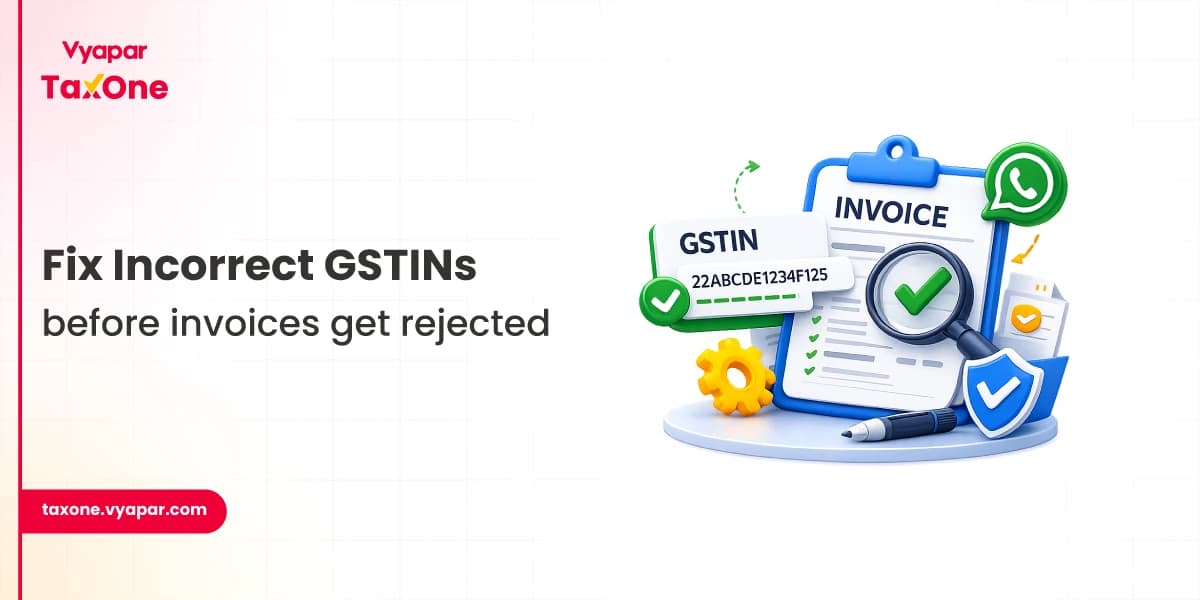
Even in 2026, incorrect GSTIN entries in invoices remain one of the most common yet critical compliance errors for businesses and tax professionals in India.
A single incorrect GSTIN can trigger reconciliation mismatches, delay Input Tax Credit (ITC), create customer disputes, and complicate return filing.
With increasing reliance on digital GST ecosystems, automated reconciliation tools, and structured compliance workflows, the margin for manual errors has significantly reduced. However, invoice volumes have increased dramatically. This means that small data entry mistakes can scale into thousands of compliance exceptions
For tax professionals handling multiple clients, the challenge is no longer just identifying incorrect GSTINs; it is implementing GSTIN validation automation and mass GSTIN verification processes that detect errors early and prevent them from spreading across accounting cycles.
This blog explains the bulk GSTIN validation process in 2026, how to efficiently identify supplier GSTIN errors, and practical strategies for implementing scalable validation systems.
A wrong GSTIN does not always mean an invalid number. In practice, several types of GSTIN errors appear during invoice reviews and GST reconciliation.
1. Invalid GSTIN format
GSTIN does not match the standard 15-digit structure.
2. Wrong GSTIN assigned to a customer/vendor
The GSTIN belongs to another entity.
3. Incorrect state registration used
Companies with multiple GST registrations may accidentally use the wrong state GSTIN.
4. Cancelled or inactive GSTIN used in invoices
5. Vendor master data mismatch
Customer or supplier data in ERP differs from GST registration records.
Each of these issues requires supplier GSTIN verification processes and vendor error-identification workflows to ensure invoices remain compliant.
GST compliance has become increasingly data-driven and system-controlled. Errors that previously went unnoticed now surface quickly during reconciliation or recipient review.
Several factors make GSTIN validation automation essential today:
1. Increased Invoice Volumes
Businesses generate thousands of invoices each month. Manual verification is no longer practical.
2. Automated Reconciliation Systems
Modern GST reconciliation systems automatically match invoices against returns and transaction records. Even minor mismatches create exceptions.
3. Faster Compliance Timelines
Organisations expect tax teams to complete reconciliation, filing, and exception management faster than before.
4. Multi-System Data Flow
Invoice data often flows through ERP systems, billing tools, Excel imports, and client integrations, increasing the risk of incorrect GSTIN mapping.
For tax professionals, this means wrong GSTIN detection must happen early, before return filing or reconciliation begins.
Based on industry experience, incorrect GSTINs typically originate from operational gaps rather than compliance failures.
Common Causes
Without mass GSTIN verification processes, these mistakes multiply quickly across invoice batches.
Incorrect GSTIN entries create operational and compliance problems across multiple departments.
Key Consequences
1. Reconciliation Mismatches
Invoices fail to match during GST reconciliation, creating unnecessary exceptions.
2. ITC Delays or Disputes
Incorrect supplier GSTINs may delay input tax credit validation.
3. Higher Compliance Workload
Tax teams spend significant time correcting invoices instead of reviewing compliance.
4. Client and Vendor Disputes
Customers may reject invoices with incorrect GSTIN details.
5. Increased Audit Risk
Incorrect data in invoice records weakens documentation during audits.
This is why many firms are adopting GSTIN validation automation tools to prevent such issues.
For tax professionals handling large datasets, the most effective approach is structured bulk GSTIN validation before return preparation.
Below is a practical workflow widely used in professional tax practices.
Start by consolidating invoice data from all sources into a standardised file format.
Typical fields include:
Clean data formatting ensures accurate mass GSTIN verification and supplier GSTIN checks.
Next, categorise invoices based on potential errors.
High-risk categories include:
This stage helps improve the accuracy of detecting incorrect GSTINs.
Now perform automated GSTIN validation across all invoice records.
A proper validation process should check:
This is where GSTIN validation automation significantly reduces manual workload.
After validation, verify GSTIN against internal vendor/customer records.
Compare:
This helps identify vendor errors caused by outdated master data.
Every GSTIN validation system should produce a clear exception report.
Typical columns include:
Structured reporting improves compliance transparency.
Clear ownership ensures faster resolution.
Typical ownership structure:
| Error Type | Responsible Team |
|---|---|
| Customer onboarding errors | Sales/Admin |
| Invoice correction | Accounts team |
| Compliance review | Tax team |
| Vendor confirmation | Client relationship manager |
Before filing returns, corrected invoices must undergo a second GSTIN verification to ensure all errors are resolved.
This final validation step prevents last-minute reconciliation issues.
Despite technological improvements, tax professionals continue to face operational challenges.
Key Challenges
1. Growing invoice volumes
High transaction volumes increase validation complexity.
2. Fragmented data systems
Invoice data is often spread across multiple tools.
3. Limited review bandwidth
Tax teams must manage compliance across multiple clients.
4. Manual reconciliation workload
5. Data accuracy issues during integrations
These challenges highlight the need for mass GSTIN verification systems supported by automation tools.
A reliable GSTIN validation system should provide the following capabilities:
Most importantly, it should integrate seamlessly with GST reconciliation workflows.
Modern tax professionals increasingly rely on intelligent platforms to manage complex GST datasets.
Vyapar TaxOne provides tools designed specifically for GST reconciliation and compliance automation.
Its GST reconciliation feature helps businesses and tax professionals streamline invoice validation, detect mismatches early, and reduce manual reconciliation work.
Key benefits include:
By integrating reconciliation and data validation, tools like Vyapar TaxOne support more efficient GSTIN validation automation and vendor error identification.
Incorrect GSTIN entries may appear small, but they can quickly escalate into significant compliance problems when invoice volumes increase.
For tax professionals in 2026, the focus must shift from reactive error correction to proactive GSTIN validation automation.
Implementing bulk GSTIN verification processes, structured exception handling, and automated reconciliation systems helps tax teams:
In an increasingly data-driven GST environment, automation and structured validation workflows are no longer optional; they are essential.
GSTIN validation automation is the process of checking GST numbers in bulk using software or automated tools to quickly identify invalid, mismatched, or inactive GSTINs.
Wrong GSTIN detection helps prevent reconciliation mismatches, ITC issues, invoice rejection, and additional compliance work.
Mass GSTIN verification saves time by validating large volumes of invoice data in a single step and reducing manual checking effort.
Common causes include outdated master data, manual entry mistakes, wrong state registration mapping, and errors during Excel import or software migration.
Yes, accurate GSTIN validation improves reconciliation quality by reducing mismatches and helping teams identify errors before return filing.

Tax Professional & Business Finance Expert
Tax Professional & Business Finance Expert
Tax Professional & Business Finance Expert