 Is Now Vyapar TaxOne | Same Trust, New Name!
 AI Weapon for Financial Soldiers
Vyapar TaxOne


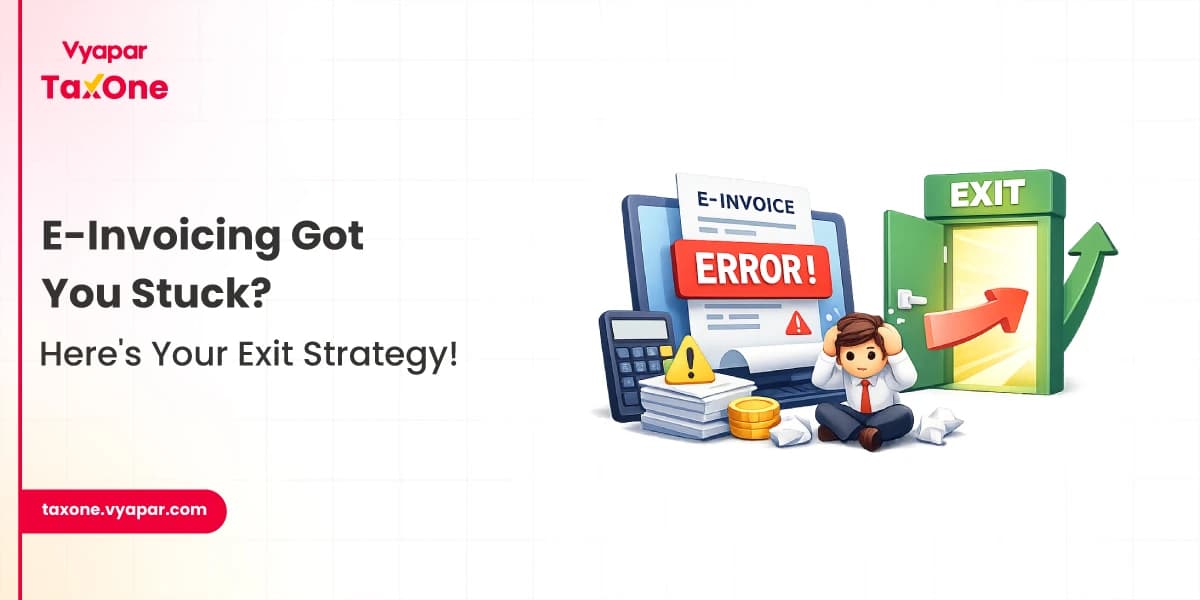
If your GSTIN is enabled for e-invoicing but your business belongs to an exempt category under GST rules, filing an e-Invoice exemption declaration can help you formally record that status on the e-Invoice portal.
Many taxpayers face confusion when the portal shows e-invoice enablement even though their business is legally exempt from issuing e-invoices. In such cases, this declaration becomes useful for clarity, smoother compliance tracking, and better internal documentation.
In this guide, we explain what an e-Invoice exemption declaration is, who should file it, which taxpayers are exempt, and how to complete the filing process on the GST portal.
An e-Invoice exemption declaration is a self-declaration available on the e-Invoice portal for taxpayers who are enabled for e-invoicing on the system but are exempt under GST rules. It is an optional facility and does not change the taxpayer’s e-invoice enablement status.
e‑Invoicing, as per the Goods and Services Tax (GST) regime, refers to the mandatory reporting of B2B invoices on the IRP by certain businesses.
The primary goal of e‑invoicing is to prevent tax evasion and ensure that the data flows seamlessly between different systems, facilitating faster compliance and reporting.
Certain businesses, regardless of their turnover, are exempt from generating e‑invoices. These include:
In cases where businesses are exempt, they must file an e‑invoice exemption declaration to notify the GST authorities and formalise their exemption status.
As a tax professional, your role is crucial in ensuring that your clients understand whether they qualify for e‑invoice exemptions and that they properly document their exemption status. Failure to file an exemption declaration could lead to:
By filing an exemption declaration, businesses formally inform the GST authorities of their exempt status under specific provisions, ensuring that their invoices are not flagged for non-compliance. The declaration process is important in preventing disputes or discrepancies during audits.
Before proceeding to file an exemption declaration, Tax Professionals must confirm whether the client is eligible for the exemption.
Key steps include:
Once the eligibility is confirmed, the next step is to file the exemption declaration on the official e‑invoice portal.
Fill in the necessary details in the exemption declaration form:


After filing the exemption declaration, ensure that the client’s invoices reflect the correct exemption status:
Keep these details ready before filing:
Challenge: As thresholds and exempt categories evolve, businesses may face difficulty in understanding whether they qualify for an exemption.
Solution: Keep track of the latest GST notifications and updates from the Central Board of Indirect Taxes & Customs (CBIC). Ensure that your clients’ turnover and operational nature are reviewed regularly to assess compliance with the changing regulations.
Challenge: Some businesses are enabled on the e‑invoice portal but may not be required to issue e‑invoices due to exemption status.
Solution: Clarify to clients that being enabled on the portal does not automatically mean e‑invoice compliance is mandatory. Ensure clients file the exemption declaration to avoid non-compliance.
Challenge: Buyers may face issues claiming ITC if their supplier has failed to file the exemption declaration or issue an e‑invoice when required.
Solution: Educate clients (both suppliers and buyers) on the importance of exemption declarations and advise them to verify supplier compliance before processing ITC claims.
Challenge: Ensuring that invoice templates in ERP systems are updated to reflect exemption status can be technically challenging for clients.
Solution: Work with your clients' IT teams to ensure that the invoice footer and exemption status are correctly incorporated into the system. Regular system updates will help ensure compliance is maintained automatically.
As India moves towards full digitalisation of its tax system, compliance with the e‑invoice mandate and exemption declaration filing becomes increasingly important.
By understanding the exemption categories, properly filing the declaration on the e‑invoice portal, and maintaining the necessary documentation, you can help clients manage risk, preserve ITC, and stay audit-ready in this evolving tax landscape.
Stay proactive, stay informed, and ensure your clients are always ahead in the compliance game.
Similar Interesting Read: IMS Cycle in GST: How Invoice Management Works & Its Process
The e‑invoice exemption allows certain businesses to be exempt from the requirement of generating e‑invoices, even if their turnover exceeds the prescribed threshold. Exemptions are based on business type, such as banks, government bodies, transporters, and SEZ units.
To determine exemption, check if your client falls under categories like banks, NBFCs, government entities, or transport agencies. Additionally, review the latest GST notifications to verify the client’s exemption eligibility.
To file the exemption declaration, log into the e‑invoice portal (einvoice.gst.gov.in), navigate to the exemption declaration section, select the applicable exemption category, and submit the form using the authorized signatory’s DSC or EVC.
Failure to file the exemption declaration can lead to audit risks, challenges in claiming ITC by buyers, and potential penalties for non-compliance with GST regulations.
Yes, businesses that are exempt from e‑invoicing should include a declaration on their invoices stating their exemption status, which helps buyers validate their eligibility to claim ITC.
No. The e-Invoice exemption declaration facility is optional and meant for taxpayers who are enabled for e-invoicing but exempt under GST rules. Filing it does not change the taxpayer’s enablement status on the portal.

Tax Professional & Business Finance Expert
Tax Professional & Business Finance Expert
Tax Professional & Business Finance Expert