 Is Now Vyapar TaxOne | Same Trust, New Name!
 AI Weapon for Financial Soldiers
Chartered Accountant


I was commuting one busy morning in an auto-rickshaw when I struck up a conversation with the driver, who happened to also be a small business owner.
As we navigated through the Surat city traffic, he shared his struggles with GST registration and how confusing and overwhelming the process felt for someone juggling daily business challenges.
Our chat quickly turned into a deep dive on GST, its complexities, and the recent government reforms aimed at making life easier for small entrepreneurs like him.
That conversation stayed with me, and it’s why I decided to write this guide. Goods and Services Tax (GST) is intended to unify India’s tax system and simplify compliance. For small businesses, it is more than a mandatory registration once certain turnover limits are crossed; it’s a chance to build credibility and claim financial benefits like input tax credit.
And now, in 2025, with certificates issued within 3 working days and refunds processed in 7, the process is smoother and faster than ever.
If you’re a small business owner wanting to complete GST registration stress-free, this guide covers all the steps, eligibility, practical tips, and latest updates to keep you confidently compliant.
GST integrates multiple indirect taxes into one unified system, consisting primarily of CGST (Central), SGST (State), and IGST (Interstate supplies).
1.1 Annual turnover criteria: ₹40 lakh for goods (₹20 lakh for services in most states).
1.2 Businesses involved in interstate sales or e-commerce must register regardless of turnover.
1.3 Special scheme thresholds such as ₹1.5 crore or ₹50 lakh for composition scheme entities.
2.1 PAN card of the business and owners/promoters.
2.2 Aadhaar card of the applicant.
2.3 Proof of business address (rental agreement, electricity bill, property tax receipt).
2.4 Bank account details with a cancelled cheque.
2.5 Business constitution proof (incorporation certificate, partnership deed).
2.6 Passport-sized photographs of proprietors/partners/directors.
3.1 Visit www.gst.gov.in → Services → Registration → New Registration.
3.2 Fill Part A with PAN, email, and mobile number; verify OTP to generate Temporary Reference Number (TRN).
3.3 Use TRN to fill Part B with detailed business, promoter, and bank information.
4.1 Upload scanned copies of documents as per the business type.
4.2 Choose Aadhaar authentication with biometric verification for faster processing (optional but recommended).
4.3 Submit an application with a Digital Signature Certificate (DSC) for companies or an electronic verification code (EVC) for proprietorships.
5.1 GST officers process applications within 3 working days for most cases under the reformed system.
5.2 Physical verification is possible, but only with prior approval of a Joint Commissioner and proper documentation.
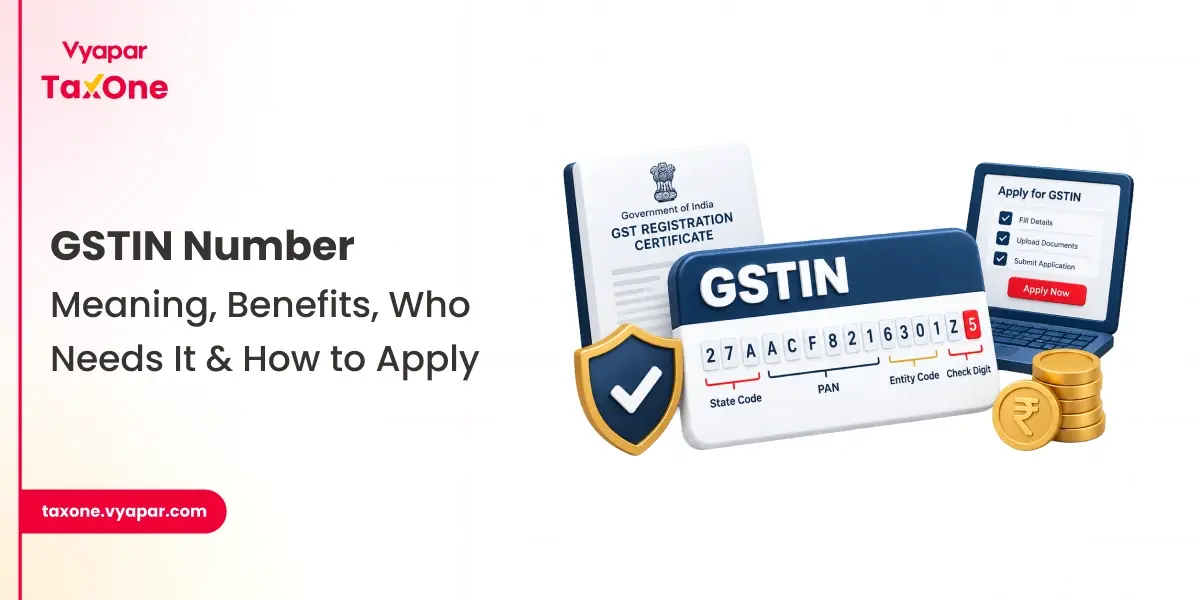
5.3 Upon approval, the GSTIN and registration certificate are issued and available for download.
6.1 Use the Application Reference Number (ARN) generated at submission to monitor the status on the GST portal.
6.2 Address any queries promptly to avoid delays.
As I wrapped up my chat with the small business owner, it became clear how vital timely GST registration is for success.
My advice: keep your documents ready, follow the straightforward steps, and use innovative tools like Vyapar TaxOne to automate GST filing and reconciliation, saving you time and preventing errors.
With new reforms ensuring quick registration and refunds, staying compliant is easier than ever.
For more help, visit the official GST portal or consult experts. Your smooth GST journey starts now!
Businesses with annual turnover above ₹40 lakh (for goods) or ₹20 lakh (for services) are required to register. Also, those involved in interstate supply or e-commerce sales require compulsory GST registration irrespective of turnover.
As per the latest government reforms in 2025, registration certificates are issued within 3 working days after submitting a complete application with proper verification.
Essential documents include PAN and Aadhaar cards, business address proof, bank account details, proof of business constitution, and photographs of the owners or partners. Aadhaar-based biometric authentication is recommended for faster processing.
Yes, GST registration is mandatory even if sales are through a proprietary website and not on third-party marketplaces like Amazon or Flipkart.
Under the 2025 GST guidelines, refunds are processed promptly, typically within 7 working days from the date of application approval.


Tax Professional & Business Finance Expert
Tax Professional & Business Finance Expert
Tax Professional & Business Finance Expert