 Is Now Vyapar TaxOne | Same Trust, New Name!
 AI Weapon for Financial Soldiers
CA


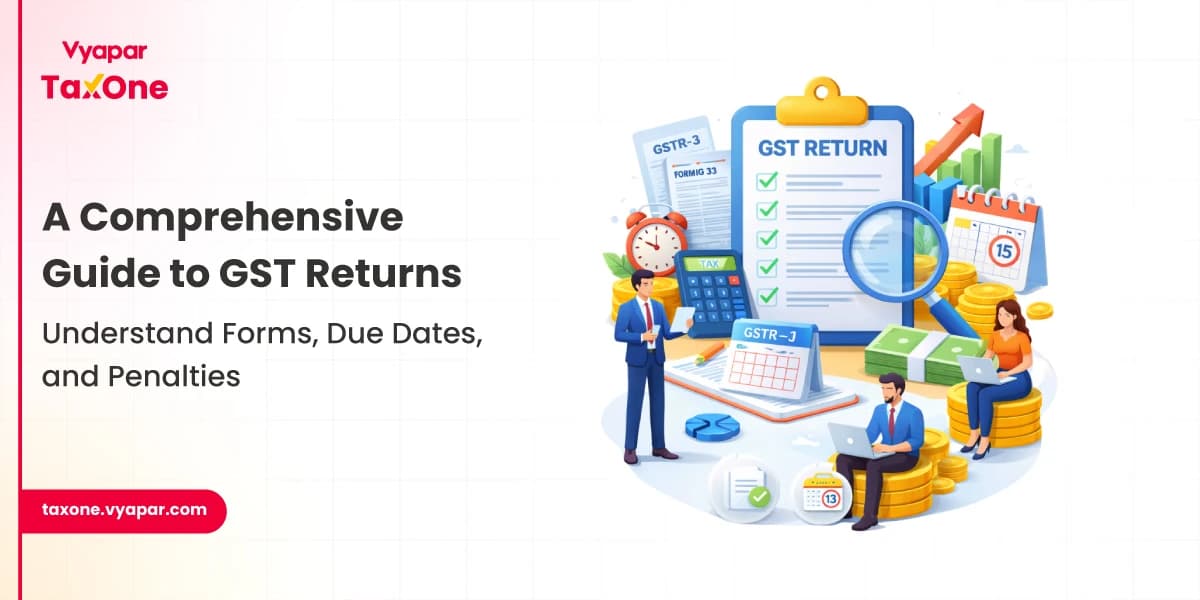
In India, GST compliance is critical for businesses and tax professionals alike.
Filing accurate and timely GST returns ensures adherence to the law and maintains the smooth functioning of business operations.
This guide will provide an in-depth understanding of GST return filing, including forms, due dates, penalties, and how to streamline the process with advanced tools such as Vyapar TaxOne's GST reconciliation feature.
A GST return is a mandatory document that businesses must file, providing detailed information on sales, purchases, and taxes paid. Filing accurate returns is essential for:
Proper GST filing supports tax authorities in ensuring tax compliance across all registered taxpayers.
GST return filing is required for every registered taxpayer, but the type and frequency of returns depend on the business type:
Businesses must ensure they file the correct returns according to their category.
GSTR-1 includes details of outward supplies (sales).
Tips for Filing GSTR-1:
GSTR-3B is a summary return detailing outward supplies, inward supplies, and the tax payable.
Common Challenges with GSTR-3B:
GSTR-9 consolidates all monthly/quarterly returns for the year.
GSTR-9C is required for entities with an annual turnover of more than ₹5 crores. It reconciles the financial statements with GST returns.
| Return Type | Due Date | Filing Frequency |
|---|---|---|
| GSTR-1 | 11th of each month | Monthly or Quarterly |
| GSTR-3B | 20th of each month | Monthly |
| GSTR-9 | 31st December of the next fiscal year | Annual |
| GSTR-9C | 31st December of the next fiscal year | Annual |
Proactive Management:
Some common challenges faced by businesses include:
Late Filing Penalties
Errors and Misreporting
Revisions and Corrections:
Reconciliation of purchase invoices (GSTR-2A/2B) with sales data is crucial. This helps verify that ITC claims align with GST returns.
Steps for Reconciliation:
Role of Automation in GST Filing
Automation reduces human error, speeds up data entry, and ensures accurate reconciliation. Tax professionals can rely on technology to:
Case for Using Vyapar TaxOne
Tax professionals can automate reconciliation and file returns more efficiently using tools like Vyapar TaxOne.
Vyapar TaxOne's GST reconciliation feature automates the matching of GSTR-2A/2B with the books, enabling real-time identification of discrepancies.
Key Benefits:
For more details, visit Vyapar TaxOne's GST reconciliation feature
GST return filing is an essential task that tax professionals must manage with precision. By understanding the various return forms, deadlines, and penalties, professionals can ensure their clients remain compliant.
Utilizing tools like Vyapar TaxOne for automated reconciliation ensures accuracy, saves time, and reduces the risk of penalties. With the right processes and technology in place, businesses can navigate GST compliance smoothly.
Yes, returns can be revised, but the revisions must be completed within the same financial year to avoid penalties.
If a return is filed late, a late fee is applied, along with interest on the unpaid tax amount.
ITC mismatches can be corrected by revising the return and ensuring data from GSTR-2A/2B matches business records.
Automation is not compulsory but is highly recommended to reduce errors, save time, and improve the filing process.

Tax Professional & Business Finance Expert
Tax Professional & Business Finance Expert
Tax Professional & Business Finance Expert