 Is Now Vyapar TaxOne | Same Trust, New Name!
 AI Weapon for Financial Soldiers
Vyapar TaxOne


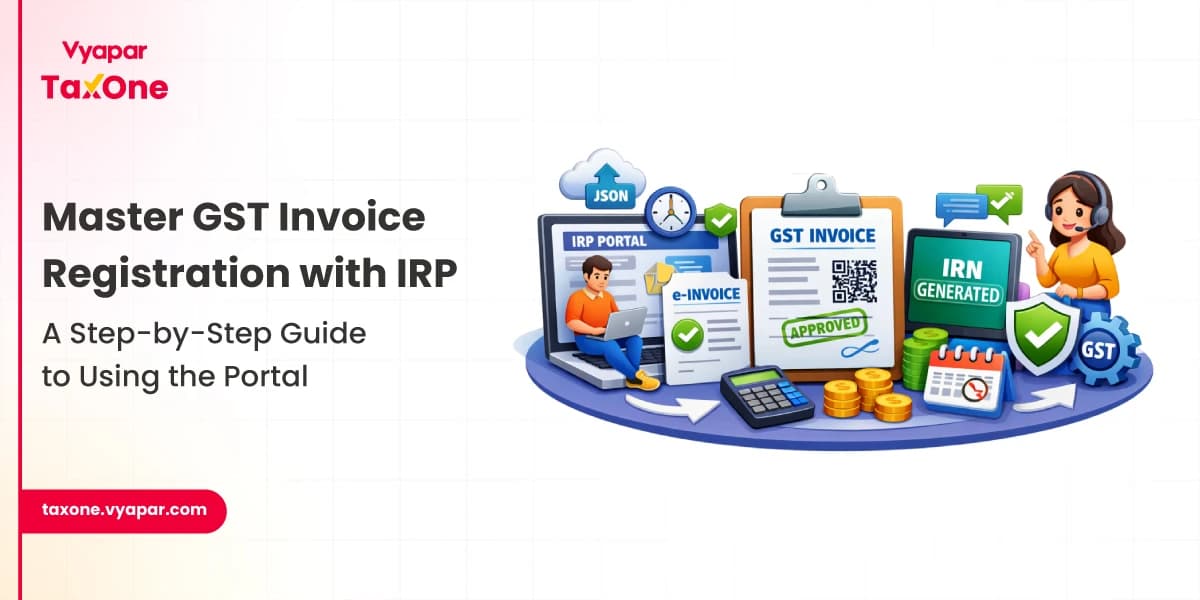
The Goods and Services Tax system in India has brought about several changes to simplify and streamline taxation processes.
One of the key components of this system is the GST Invoice Registration Portal (IRP). For tax professionals, understanding how to navigate the IRP is essential to ensuring compliance, reducing errors, and improving efficiency in managing GST-related tasks.
In this article, we will explain what the GST Invoice Registration Portal (IRP) is, how it works, and how tax professionals can effectively use it to enhance their workflow.
We will also explore the Vyapar TaxOne GST reconciliation feature to help you automate your GST reconciliation and filing processes.
The GST Invoice Registration Portal (IRP) is an online platform introduced by the Government of India for the e-invoicing process under the GST regime. Its primary function is to validate and register e-invoices before they are used for GST filing and compliance.
When an invoice is uploaded to the IRP, it generates an Invoice Reference Number (IRN) and a QR Code to authenticate the transaction.
By centralizing the validation and registration of invoices, the IRP ensures invoices are accurate, prevents fraudulent activities, and streamlines auto-population into GST return and e-way bill portals.
The IRP plays a significant role in improving transparency, reducing fraud, and ensuring invoices comply with GST regulations. Key benefits include:
Not all taxpayers are required to use the IRP, but the portal is mandatory for businesses that meet certain thresholds. As per the latest regulations, any taxpayer with an annual turnover exceeding ₹5 Crore is required to register invoices through the IRP.
However, this requirement is subject to updates in line with the Government's notifications, so tax professionals should stay informed of any changes.
While the IRP is mandatory for most businesses, specific sectors or types of transactions might be exempted. For example, businesses involved in exporting goods or services, and those under the composition scheme, may not be required to generate e-invoices. Tax professionals must be aware of these exemptions and apply them accordingly.
The IRP process is simple, but it requires careful attention to detail. Below is a step-by-step guide to using the portal efficiently.
Before uploading to the IRP, an invoice must first be created in your accounting software or ERP system. Ensure that all the required information is included, such as:
Once the invoice is ready, it must be uploaded to the IRP via an API or through the web interface. The IRP accepts the invoice in JSON format for processing.
Upon receiving the invoice, the IRP validates the details provided:
After successful validation, the IRP generates an Invoice Reference Number (IRN) and a QR code, which are embedded in the e-invoice. This helps verify the invoice's authenticity and ensures it can be used for filing GST returns and creating e-way bills.
The validated e-invoice is automatically shared with the GST Network (GSTN) for inclusion in GSTR-1 and E-way Bill Portal, saving time and effort in manual entry.
The IRP provides several modes to upload invoices, depending on the scale of operations and integration preferences:
To optimize your use of the GST Invoice Registration Portal, here are some practical tips:
Many businesses use accounting software to manage GST. Integrating IRP functionality with accounting systems can streamline the process. Ensure your accounting software is compatible with GST e-invoicing systems and can automatically upload invoices to the IRP.
While manually managing GST reconciliation and filing can be time-consuming and error-prone, tools like Vyapar TaxOne simplify this process. Vyapar's GST feature is designed specifically for tax professionals to automate reconciliation and filing.
Vyapar's GST reconciliation feature helps tax professionals automate the entire process, from generating e-invoices to reconciling the data. Key features include:
Vyapar also integrates invoice management, allowing for:
For tax professionals managing multiple clients, Vyapar TaxOne provides:
By leveraging Vyapar TaxOne, tax professionals can significantly improve efficiency, reduce the risk of non-compliance, and save valuable time.
The GST Invoice Registration Portal (IRP) is a vital part of India's GST system, ensuring e-invoices are compliant, accurate, and easily processed. Tax professionals must understand how the IRP works to ensure smooth filing of GST returns and creation of e-way bills.
Using tools like Vyapar TaxOne further streamlines this process by automating reconciliation, ITC tracking, and efficient invoice management. Embracing these tools will help tax professionals stay ahead in the increasingly complex world of GST compliance.
By following the outlined steps and using the right tools, businesses can ensure their GST processes remain efficient, accurate, and compliant with government regulations.
The IRP is an online platform that validates and registers e-invoices under the GST system, providing a unique Invoice Reference Number (IRN) and QR Code.
Businesses with an annual turnover exceeding ₹5 Crore are required to use the IRP to register e-invoices.
Without an IRN, the invoice cannot be used for GST filing or generating an e-way bill.
Yes, the IRP automatically populates e-invoices into GST returns, reducing manual data entry.
Vyapar TaxOne automates GST reconciliation by matching GSTR-1, GSTR-2A, and GSTR-2B data, ensuring accurate filing and tracking of Input Tax Credit (ITC).


Tax Professional & Business Finance Expert
Tax Professional & Business Finance Expert
Tax Professional & Business Finance Expert