 Is Now Vyapar TaxOne | Same Trust, New Name!
 AI Weapon for Financial Soldiers
Vyapar TaxOne


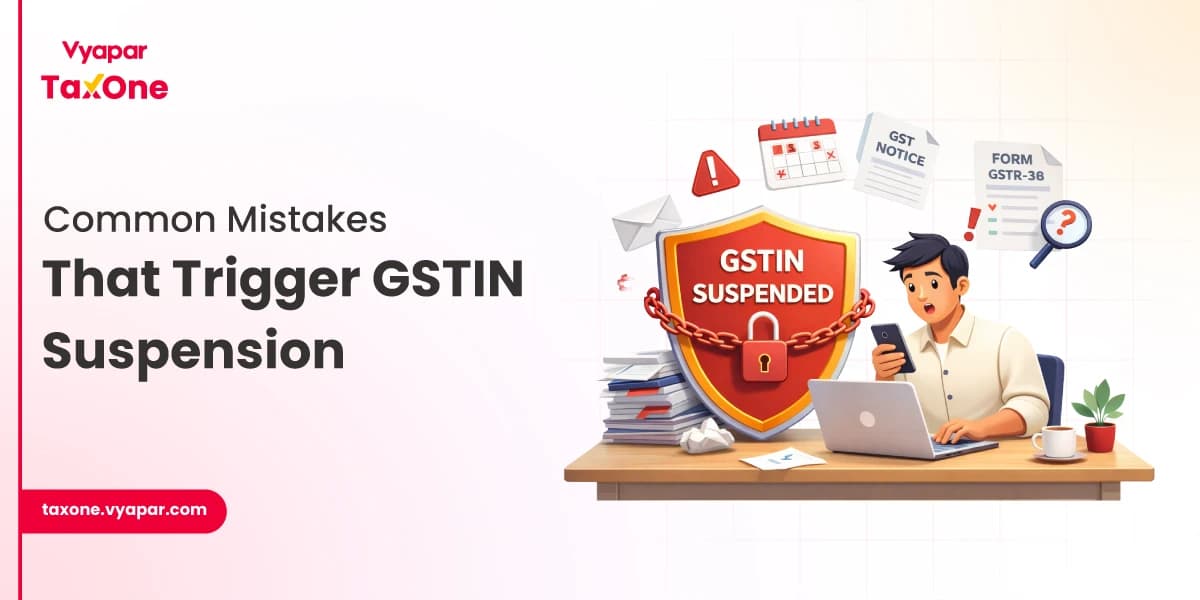
In India, the Goods and Services Tax has significantly transformed the tax system. The Goods and Services Tax Identification Number (GSTIN) plays a pivotal role for businesses, helping them to operate smoothly within the regulatory framework.
One of the growing concerns among businesses and tax professionals is the auto-suspension of GST registration, which can disrupt operations and create compliance issues.
This blog aims to equip tax professionals with practical strategies to help their clients avoid GSTIN auto-suspension. Through actionable insights and preventive measures, we will help you maintain a compliant GST registration and keep your clients' businesses running without interruption.
GSTIN auto-suspension refers to the automatic suspension of a business's GST registration on the GST portal for non-compliance with the prescribed GST rules.
When a company fails to meet key requirements, such as filing returns, paying taxes, or reconciling data, its GSTIN can be automatically suspended, preventing further transactions and hindering the ability to claim Input Tax Credit (ITC).
This suspension can occur for several reasons and directly impacts the business's operations. To avoid such disruptions, tax professionals must understand the common causes and how to mitigate them.
Understanding why GSTIN is auto-suspended can help tax professionals prevent such issues for their clients. Here are the most common reasons for auto-suspension:
One of the primary reasons for GSTIN suspension is the non-filing of GST returns. A business is required to file monthly and/or quarterly returns, such as GSTR-1 and GSTR-3B. Failing to submit these returns on time can result in the automatic suspension of the GST registration.
If a business fails to pay taxes on time, the GST portal may suspend its registration. Even a slight delay in payment can lead to significant disruptions.
A mismatch between GSTR-1 and GSTR-3B (the sales and purchase return forms) can trigger auto-suspension. Any discrepancies or errors between the returns can raise red flags for the tax authorities.
If a business fails to keep its information on the GST portal (such as PAN details, business address, or authorized signatories) up to date, it may be flagged for suspension.
Filing GST returns on time is critical to avoid auto-suspension. Here's how tax professionals can help their clients stay compliant:
| Return Type | Due Date | Frequency |
|---|---|---|
| GSTR-1 | 11th of the following month | Monthly/Quarterly |
| GSTR-3B | 20th of the following month | Monthly |
| GSTR-9 | 31st December of the following year | Annual |
To prevent GSTIN suspension due to non-payment, ensure that taxes are paid on time. Here's how you can help clients manage their tax payments effectively:
Tax Payment Reminders: Set up automatic reminders for clients to ensure timely payments. Pay Regular Dues: Encourage clients to monitor their tax obligations and clear any outstanding balances regularly. Audit Tax Payments: Conduct periodic reviews of clients' tax payment records to ensure no payments are missed.
Reconciliation of GST returns is essential to identify and resolve discrepancies. Inaccurate reporting can lead to mismatches between GSTR-1 and GSTR-3B, triggering suspension.
Ensure that all business information on the GST portal is accurate and up to date. This includes details such as:
The GST portal often issues notices and alerts regarding compliance issues, including the risk of auto-suspension. It's essential to address these notices promptly:
The increasing complexity of GST compliance has made automation essential for businesses to avoid mistakes. Here's how automation can help:
Regular education and awareness are key to ensuring compliance:
Tax professionals should regularly monitor the GSTIN status of their clients to avoid auto-suspension:
Avoiding GSTIN auto-suspension is critical for smooth business operations and compliance. By ensuring timely filings, accurate tax payments, and regular reconciliation, tax professionals can help their clients maintain an active GST registration and avoid disruptions.
Proactive monitoring and prompt addressing of notices will ensure long-term compliance.
To streamline GST compliance and reduce the risk of errors, Vyapar TaxOne offers an automation solution that simplifies GST reconciliation.
With its AI-powered features, Vyapar TaxOne automates the reconciliation of GSTR-1 and GSTR-3B, minimizes manual intervention, and ensures accurate filing, helping tax professionals stay compliant and reduce the chances of auto-suspension.
A GSTIN can be auto-suspended for non-filing of returns, non-payment of taxes, mismatches between GSTR-1 and GSTR-3B, or failure to update business information on the GST portal.
Ensure timely and accurate filing of GST returns, regular payment of taxes, and proper reconciliation of returns. Additionally, update business details regularly on the GST portal.
GST reconciliation involves matching the data between GSTR-1 (sales) and GSTR-3B (summary) to ensure consistency and avoid discrepancies that can lead to compliance issues.
Vyapar TaxOne automates GST reconciliation, reduces manual errors, and ensures timely return filing. Its AI-powered features simplify the reconciliation process and help tax professionals stay compliant.
Vyapar TaxOne automates GST return filing, ensuring accurate, timely submissions of GSTR-1, GSTR-3B, and other required returns, minimizing the risk of errors and delays.

Tax Professional & Business Finance Expert
Tax Professional & Business Finance Expert
Tax Professional & Business Finance Expert