 Is Now Vyapar TaxOne | Same Trust, New Name!



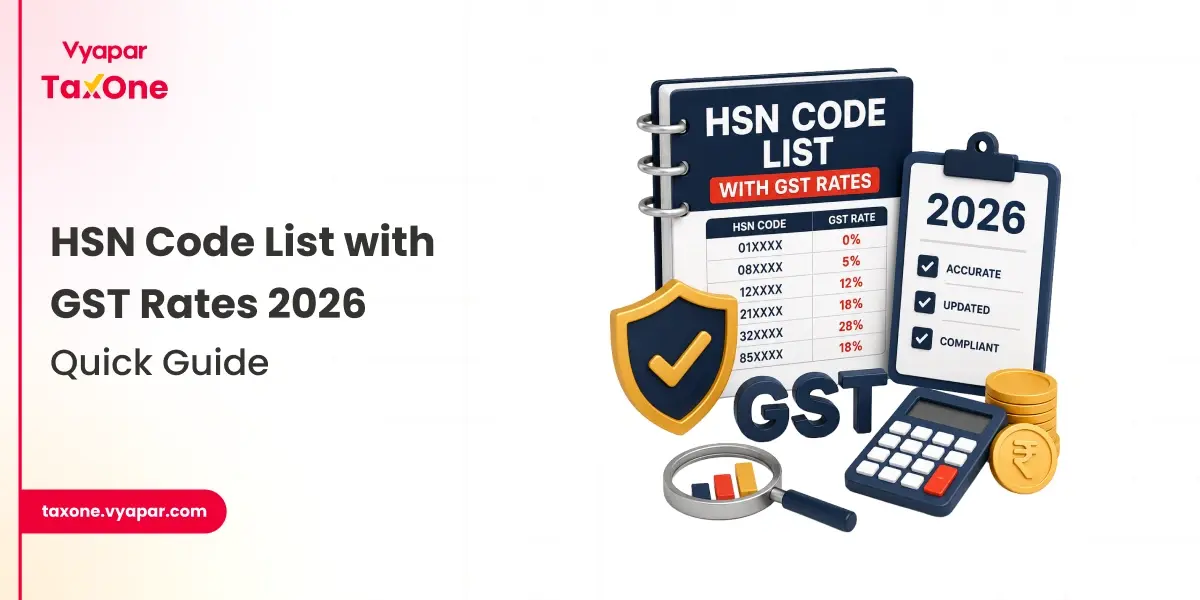
HSN codes help businesses classify goods correctly for GST invoicing and return filing. Choosing the right HSN code is important because the applicable GST rate depends not only on the broad product category but also on the exact description, material, value, packaging, and other conditions specified in the GST rate notification.
GST rates on a large number of goods were rationalised from 22 September 2025. The revised structure broadly uses a 5% merit rate, 18% standard rate and 40% demerit rate, while Nil-rated goods and special rates such as 3%, 1.5% and 0.25% continue for specified products. (Goods & Services Tax Council)
This guide provides an updated 2026 HSN code and GST rate quick reference for commonly used products, along with HSN reporting requirements and steps to find the correct HSN code.
Important: This is a quick-reference list, not a substitute for the Customs Tariff or GST rate notifications. The exact product description under the relevant tariff entry should always be checked before finalising an HSN code or GST rate.
What Is an HSN Code?
HSN stands for Harmonised System of Nomenclature. It is a standard system used to classify goods for taxation, customs and international trade.
An HSN code becomes more specific as the number of digits increases.
| HSN Level | Classification |
|---|---|
| 2 digits | Chapter |
| 4 digits | Heading |
| 6 digits | Sub-heading |
| 8 digits | Tariff item |
For example, a four-digit heading identifies a broad category of goods, while six- or eight-digit codes provide a more precise product classification.
The GST Portal's HSN search facility displays related classifications in 4, 6, and 8 digits and allows taxpayers to search either through the HSN code or a product description. (GST Tutorial)
Updated HSN Code List with GST Rates for 2026
The following table includes commonly searched products whose rate treatment can be supported by official GST rate documents.
Food and Grocery HSN Codes
| Product | HSN Code | GST Rate | Important Condition |
|---|---|---|---|
| UHT milk | 0401 | Nil | Specifically exempt |
| Chena or paneer | 0406 | Nil | Pre-packaged and labelled |
| Butter, ghee and other milk fats | 0405 | 5% | Specified goods under heading |
| Pasta, macaroni and noodles | 1902 | 5% | Includes prepared/unprepared pasta covered by heading |
| Corn flakes and specified cereal preparations | 1904 | 5% | Subject to tariff exclusions |
| Pastry, cakes and biscuits | 1905 | 5% | Excludes separately Nil-rated Indian breads |
| Pizza bread | 1905 | Nil | Specifically exempt |
| Khakhra, chapati or roti | 1905 / 2106 | Nil | Specifically exempt |
| Paratha, parotta and other Indian breads | 2106 | Nil | Specifically exempt |
| Sauces, mixed condiments and seasonings | 2103 | 5% | Includes specified sauces/preparations |
| Ice cream and other edible ice | 2105 00 00 | 5% | Whether or not containing cocoa |
| Namkeen, bhujia, mixture and chabena | 2106 90 | 5% | Ready-to-consume specified preparations |
The GST Council reduced UHT milk, pre-packaged and labelled chena/paneer and Indian breads to Nil, while a wide range of foods including pasta, sauces, chocolates, cornflakes, butter and ghee moved to 5%. The current rate schedule also places specified namkeen and similar ready-to-consume preparations under the 5% schedule. (Food and Grocery HSN Codes)
Important 2026 Update for Beverages
The tariff classification of several beverages under HSN 2202 was updated in April 2026 through Notification No. 01/2026-Central Tax (Rate).
| Product Category | HSN / Tariff Item | GST Rate |
|---|---|---|
| Specified fruit juice-based and milk-based beverages | 2202 99 21, 2202 99 29, 2202 99 31, 2202 99 39 | 5% |
| Specified caffeinated beverages | 2202 99 90 etc. | 40% |
| Specified non-alcoholic beverages | 2202 99 91 / related revised tariff entries | 40% |
The April 2026 amendment aligned the GST schedule with the revised tariff classification introduced through the Finance Act, 2026. (Goods & Services Tax Council Newsletter)
Education and Stationery HSN Codes
One of the important corrections from older HSN-GST lists concerns notebooks, pencils and similar educational items.
| Product | HSN Code | GST Rate |
|---|---|---|
| Erasers | 4016 | Nil |
| Maps, atlases and specified printed charts | 4905 | Nil |
| Pencil sharpeners | 8214 | Nil |
| Pencils, crayons, pastels, drawing charcoal and tailor's chalk | 9608 / 9609 | Nil |
| Exercise books | 4820 | Nil |
| Graph books | 4820 | Nil |
| Laboratory notebooks | 4820 | Nil |
| Notebooks | 4820 | Nil |
| Mathematical boxes | 7310 / 7326 | 5% |
| Geometry boxes | 7310 / 7326 | 5% |
| Colour boxes | 7310 / 7326 | 5% |
Specified erasers moved from 5% to Nil, while notebooks, pencil sharpeners and specified pencils/crayons moved from 12% to Nil. Mathematical, geometry and colour boxes moved from 12% to 5%. (Education and Stationery HSN Codes)
Why the Exact Product Description Matters
HSN 4820 is a useful example of why businesses should not assign GST rates using only the four-digit heading.
Specified notebooks and exercise books are Nil-rated, but other products falling under HSN 4820 - such as certain registers, account books, order books, and receipt books - remain separately covered under the taxable schedule.
So:
HSN 4820 does not automatically mean Nil GST for every product under that heading.
The product description matters.
Household and Common-Use Product HSN Codes
| Product | HSN Code | GST Rate |
|---|---|---|
| Tooth powder | 3306 10 10 | 5% |
| Candles and tapers | 3406 | 5% |
| Safety matches | 3605 00 10 | 5% |
| Feeding bottles | 3926 | 5% |
| Feeding-bottle nipples | 4014 | 5% |
| Cotton handbags/shopping bags | 4202 22 20 | 5% |
| Jute handbags/shopping bags | 4202 22 30 | 5% |
| Wooden tableware and kitchenware | 4419 | 5% |
| Umbrellas | 6601 | 5% |
| Iron/steel household articles and utensils | 7323 | 5% |
| Copper household articles and utensils | 7418 | 5% |
| Aluminium household articles and utensils | 7615 | 5% |
| Sewing machines | 8452 | 5% |
| Bicycles | 8712 | 5% |
| Furniture wholly made of bamboo, cane or rattan | 9403 | 5% |
It is also important not to generalise HSN 9403 as 5%. The concessional entry applies specifically to furniture wholly made of bamboo, cane or rattan; other furniture under HSN 9403 falls under a different rate entry. (Household and Common-Use Product HSN Codes)
Medicines and Medical Equipment HSN Codes
The healthcare sector received significant GST rate reductions from September 2025.
| Product | HSN Code | GST Rate |
|---|---|---|
| General drugs and medicines | Chapter 30 | 5% |
| Medicaments not put up in measured retail doses | 3003 | 5% |
| Medicaments in measured doses/retail packs | 3004 | 5% |
| Wadding, gauze, bandages and specified dressings | 3005 | 5% |
| Specified pharmaceutical goods | 3006 | 5% |
| Diagnostic kits and reagents | 3822 | 5% |
| Surgical/medical examination rubber gloves | 4015 | 5% |
| Glucometers and test strips | Chapter 90 or applicable chapter | 5% |
| Medical, surgical, dental or veterinary instruments | 9018 | 5% |
| Medical thermometers | 9025 | 5% |
| Specified medical analysis instruments | 9027 | 5% |
The 56th GST Council changes reduced all other drugs and medicines from 12% to 5%, while specified life-saving drugs were moved to Nil. Medical instruments and supplies such as diagnostic kits, gauze, bandages and various medical devices were also reduced to 5%. (Medical Equipment HSN Codes)
Are All Medicines Taxed at 5%?
No.
A blanket statement such as “HSN 3004 = 5% for every medicine” can be misleading because specified life-saving medicines are separately exempt.
The correct formulation is:
Most taxable drugs and medicines under Chapter 30 attract 5%, except medicines specifically covered by Nil-rate exemptions or another applicable entry.
Building Material and Industrial HSN Codes
| Product | HSN Code | GST Rate |
|---|---|---|
| Cement | 2523 | 18% |
| Iron/non-alloy steel bars and rods | 7213-7215 | 18% |
| Iron/steel angles, shapes and sections | 7216 | 18% |
| Iron/steel tubes and pipes | 7304-7306 | 18% |
| Iron/steel pipe fittings | 7307 | 18% |
| Iron/steel nails | 7317 | 18% |
| Screws, bolts and nuts | 7318 | 18% |
Cement under heading 2523 was specifically reduced from 28% to 18%. The current rate schedule places the specified cement products under the 18% schedule. (Building Material and Industrial HSN Codes)
Electronics and Appliances HSN Codes
| Product | HSN Code | GST Rate |
|---|---|---|
| Printers, copying and facsimile machines | 8443 | 18% |
| Computers and automatic data-processing machines | 8471 | 18% |
| Air-conditioning machines | 8415 | 18% |
| Televisions and computer monitors | 8528 | 18% |
| Electric accumulators/batteries | 8507 | 18% |
| Insulated electric wires and cables | 8544 | 18% |
The official current 18% schedule includes HSN 8415 air-conditioning machines, HSN 8443 printing machinery/printers, HSN 8471 automatic data-processing machines, and HSN 8528 television sets and computer monitors. (Electronics and Appliances HSN Codes)
The September 2025 reform also specifically reduced air-conditioning machines and televisions previously subject to higher rates to 18%.
Clothing and Footwear HSN Codes
For apparel and footwear, the sale value threshold matters.
| Product | HSN | Sale Value | GST Rate |
|---|---|---|---|
| Knitted/crocheted apparel | Chapter 61 | Up to ₹2,500 per piece | 5% |
| Knitted/crocheted apparel | Chapter 61 | Above ₹2,500 per piece | 18% |
| Other apparel | Chapter 62 | Up to ₹2,500 per piece | 5% |
| Other apparel | Chapter 62 | Above ₹2,500 per piece | 18% |
| Footwear | Chapter 64 | Up to ₹2,500 per pair | 5% |
| Footwear | Chapter 64 | Above ₹2,500 per pair | 18% |
The current GST rate schedule expressly places apparel under Chapters 61 and 62 with a sale value not exceeding ₹2,500 per piece, and footwear not exceeding ₹2,500 per pair, in the 5% schedule. Higher-value apparel is placed in the 18% schedule. (Clothing and Footwear HSN Codes)
Automobile HSN Codes and GST Rates
| Product | HSN Code | GST Rate |
|---|---|---|
| Buses for 10 or more persons, subject to specified entry | 8702 | 18% |
| Specified small petrol/LPG/CNG cars | 8703 | 18% |
| Specified small diesel cars | 8703 | 18% |
| Three-wheelers | 8703 | 18% |
| Specified goods vehicles | 8704 | 18% |
| General motor-vehicle parts covered by applicable entry | 8708 | 18% |
| Motorcycles not exceeding 350cc | 8711 | 18% |
| Motorcycles exceeding 350cc | 8711 | 40% |
The official transportation-sector annexure moved motorcycles up to 350cc, buses, trucks, three-wheelers and specified motor vehicles to 18%, while motorcycles above 350cc were placed in the 40% category. (Automobile HSN Codes)
Vehicle classification is particularly condition-sensitive. For cars, factors such as fuel type, engine capacity, and vehicle length determine whether the 18% or 40% entry applies. (Tax Information)
Gold and Jewellery HSN Codes
Special GST rates continue outside the main 5%, 18% and 40% structure.
| Product | HSN Code | GST Rate |
|---|---|---|
| Gold, unwrought/semi-manufactured | 7108 | 3% |
| Silver, unwrought/semi-manufactured | 7106 | 3% |
| Articles of jewellery of precious metal | 7113 | 3% |
| Goldsmiths'/silversmiths' wares | 7114 | 3% |
| Imitation jewellery | 7117 | 3% |
| Rough/simply sawn diamonds | 7102 | 0.25% |
| Other polished diamonds under 7102 | 7102 | 1.5% |
Notification No. 9/2025 places precious-metal jewellery under the 3% schedule, while specified rough diamonds and other diamond categories continue under separate 0.25% and 1.5% schedules. (Gold and Jewellery HSN Codes)
What Are the GST Rate Slabs in 2026?
For goods, the current framework broadly includes:
- Nil – Exempt goods specifically listed in the Nil-rate notification
- 5% – Merit-rate goods
- 18% – Standard-rate goods
- 40% – Specified luxury, demerit and other notified goods
- 3% – Specified precious metals and jewellery
- 1.5% – Certain diamonds/synthetic stones
- 0.25% – Specified rough diamonds and precious stones
The 2025 notification originally retained a 28% schedule for specified tobacco-related goods during transition. From 1 February 2026, Notification No. 19/2025 moved bidis to 18% and specified pan masala, tobacco, cigarettes and related products to 40%, while Schedule VII (28%) was omitted. (GST Rate Slabs in 2026)
How Many HSN Digits Are Mandatory in 2026?
For Table 12 of GSTR-1/GSTR-1A, the GST Portal currently requires HSN reporting based on Aggregate Annual Turnover in the preceding financial year.
| Aggregate Annual Turnover | HSN Requirement |
|---|---|
| Up to ₹5 crore | Minimum 4 digits |
| Above ₹5 crore | Minimum 6 digits |
Phase 3 of Table 12 HSN reporting has applied from the May 2025 return period. Taxpayers can no longer manually enter an arbitrary HSN in Table 12; the HSN must be selected from the available dropdown. (GST Tutorial)
For invoices, the established HSN requirement provides for a six-digit HSN/SAC for taxpayers above ₹5 crore and four digits for B2B supplies by taxpayers up to ₹5 crore. (CBIC GST)
How to Find the Correct HSN Code on the GST Portal
The GST Portal provides an official Search HSN Code facility.
Go to:
- GST Portal → Services → User Services → Search HSN Code
You can search using either:
-
HSN Code – if you already know part of the code.
-
Description – if you know the name or trade description of the product.
Search results can show the chapter heading, HSN code, technical description, commonly used trade description and related 4-, 6- or 8-digit classifications. The HSN directory can also be downloaded in Excel format. (Guide to Find the Correct HSN Code)
However, GSTN expressly states that its Search HSN facility is meant for taxpayer facilitation and is not legally binding classification advice. The final classification should therefore be checked against the Customs Tariff and applicable GST notifications where there is doubt.
How to Choose the Correct HSN Code
Start by identifying the product precisely, including its material, composition, function, packaging and use. Next, determine the relevant HSN chapter and heading before narrowing the classification to six or eight digits where required. After identifying the HSN, separately confirm whether the exact product description appears under a Nil, 5%, 18%, 40% or special-rate entry. Do not determine the GST rate merely from the four-digit HSN number. This distinction is particularly important for headings such as 4820, 9403, 8703 and Chapter 30, where products within the same broader classification can receive different GST treatment.
Common HSN Code Mistakes to Avoid
- Using an old GST rate list
A large number of GST rates changed from 22 September 2025. Product masters based on older 12% or 28% rates may therefore be outdated. (Latest GST Rate List)
- Assuming one HSN heading always has one GST rate
The same four-digit heading can contain differently taxed products. HSN 4820 is a clear example: specified notebooks are Nil-rated, while other stationery products within 4820 can remain taxable.
- Ignoring product-specific conditions
GST classification may depend on sale value, packaging, material, engine capacity, intended use or another condition contained in the notification.
- Copying an HSN from another invoice
A supplier's invoice can help as a reference but does not establish that the HSN is legally correct for every similar product.
- Using an outdated product master
Businesses and tax professionals should review stored HSN codes whenever GST notifications change instead of updating only the tax percentage.
Why Correct HSN Classification Is Important
Accurate HSN classification helps businesses and tax professionals apply the correct GST rate, prepare compliant invoices, report HSN-wise supplies correctly in GSTR-1, and reduce mismatches between books and GST returns.
It can also reduce the risk of underpayment or excess payment of GST caused by incorrect product classification. For CAs and tax professionals managing multiple clients, maintaining an updated item-wise HSN and GST rate master can make invoice review, reconciliation, and return preparation more consistent.
Conclusion
Using the correct HSN code and GST rate is essential for accurate invoicing and GST compliance. This is particularly important in 2026 because the September 2025 GST rationalisation changed the tax treatment of a large number of goods, and additional changes - including the beverage classification update - were made in 2026. (Latest HSN Codes and GST Rates)
Businesses, CAs and tax professionals should check the exact product description and applicable GST notification, rather than relying only on an old HSN-GST rate list or a broad four-digit heading. Once the classification is verified, maintaining the correct HSN and GST rate in the product master can help reduce billing and return-filing errors.
Disclaimer: This article is intended for general informational purposes and reflects official GST material checked up to 3 September 2026. HSN classification and GST rates can depend on the exact product description, specifications, packaging, value and statutory conditions. For a specific transaction, verify the applicable Customs Tariff entry and latest CBIC/GST notification or consult a qualified tax professional.
FAQs
What is an HSN code under GST?
HSN stands for Harmonised System of Nomenclature. It is used to classify goods for GST, customs, and international trade.
What are the main GST rates in 2026?
For goods, the principal current rates are 5%, 18% and 40%, along with Nil-rated goods and special rates such as 3%, 1.5% and 0.25% for specified categories. The earlier transitional 28% tobacco schedule was removed from 1 February 2026.
Is the 12% GST slab still applicable in 2026?
The September 2025 rate rationalisation moved a large number of goods previously taxed at 12% to 5%, Nil or another rate. Businesses should therefore check the current notification rather than continuing to use an old 12% product master.
Is the 28% GST slab applicable in 2026?
The 28% Schedule VII that temporarily covered specified tobacco products under Notification 9/2025 was omitted from 1 February 2026. Those products were moved primarily to 18% or 40%, depending on the specified product.
What is the GST rate for notebooks in 2026?
Specified exercise books, graph books, laboratory notebooks and notebooks under HSN 4820 are Nil-rated. Other products under heading 4820 should not automatically be treated as Nil.
What is the GST rate for pencils in 2026?
Specified pencils, crayons, pastels, drawing charcoal and tailor's chalk falling under the notified entries of HSN 9608/9609 are Nil-rated. This does not mean every product under HSN 9608 is Nil-rated.
What is the GST rate for cement in 2026?
Specified cement falling under HSN 2523 attracts 18% GST. The rate was reduced from 28% to 18% from the September 2025 rate rationalisation.
What is the GST rate for medicines in 2026?
Most taxable drugs and medicines are covered at 5%, while specified life-saving medicines are Nil-rated. The exact medicine should therefore be checked against the exemption and rate schedules.
Is four-digit HSN mandatory?
For GSTR-1 Table 12, taxpayers with AATO up to ₹5 crore must report a minimum four-digit HSN, while taxpayers above ₹5 crore must report a minimum six-digit HSN. GST Tutorial
Where can I check an HSN code officially?
Use the GST Portal: Services → User Services → Search HSN Code. You can search by either HSN number or product description. Guide to check HSN Code
Can two products under the same HSN heading have different GST rates?
Yes. GST treatment can depend on the exact tariff description, product characteristics, value, packaging and specific exemption or rate entry. Therefore, a broad four-digit HSN alone should not always be used to determine the GST rate.