 Is Now Vyapar TaxOne | Same Trust, New Name!
 AI Weapon for Financial Soldiers
CA


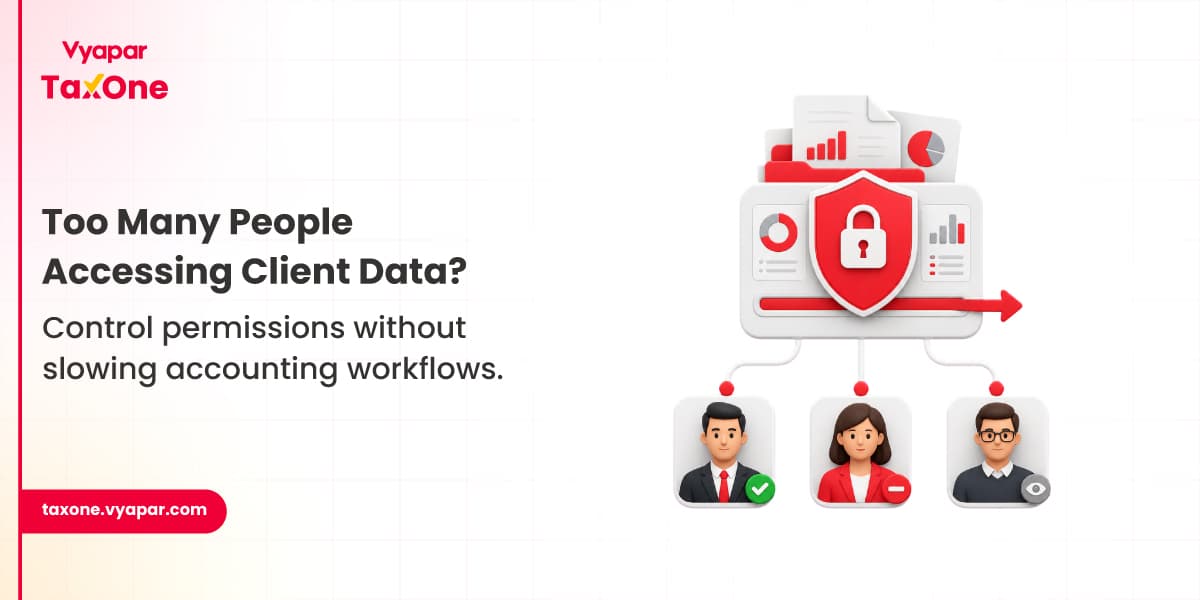
As a CA firm grows, managing access becomes more challenging than simply adding new users. Article assistants, GST executives, senior accountants, audit teams, outsourced staff, and temporary resources all contribute to client work, but not everyone needs access to the same information.
In many firms, permissions evolve without much planning. Someone receives additional access to complete an urgent task, an employee moves to another client portfolio but retains previous permissions, or temporary staff are granted broader access during filing season. These exceptions often remain long after the work is completed.
The impact usually becomes visible during reconciliation or internal reviews. Teams discover that multiple people have updated the same records, confidential documents are visible to the wrong users, or no one can clearly identify who made a particular change. At that point, the issue is no longer just about system access, it affects accountability, confidentiality, and operational efficiency.
Role-Based Access Control (RBAC) addresses this by assigning permissions according to responsibilities instead of individuals. As teams expand, firms can keep access aligned with actual work rather than allowing permissions to grow unchecked.
As client volumes increase, accounting work naturally becomes more specialized. GST teams focus on return preparation and reconciliation, accounting teams manage bookkeeping, senior accountants review completed work, and partners handle approvals.
Without a structured permission framework, employees often retain access to clients or functions they no longer manage. While this may not create an immediate issue, it increases unnecessary visibility into confidential information and makes permission management harder to control over time.
Organizing permissions around clearly defined roles helps keep system access aligned with actual responsibilities.
CA firms routinely work with bank statements, GST returns, payroll records, financial statements, tax computations, and supporting documents for multiple clients.
Not every employee needs access to every client's records.
When permissions aren't reviewed regularly, staff may continue accessing unrelated client data simply because their access was never updated after a role change. This becomes particularly important for firms handling multiple GSTINs, group companies, or large corporate clients where different teams manage different engagements.
As firms manage larger client portfolios, permission control works best alongside secure document management. When both access permissions and client files are organized together, firms reduce the chances of confidential information being shared beyond the intended team.
GST filing deadlines, tax audits, and financial year-end activities often require firms to onboard temporary resources.
To keep work moving, firms sometimes provide broader access than originally intended. Once the compliance cycle ends, reviewing those permissions often becomes a lower priority as teams move on to the next set of deadlines.
We've frequently seen outdated permissions remain active simply because no structured review process existed after temporary work was completed.
When multiple people can modify the same records, tracing changes becomes much harder.
A reconciliation difference may result from a supporting document being replaced after review, an incorrect version being uploaded, or changes being made by someone who no longer owns that client. Without controlled access, teams often spend valuable time identifying who made a change instead of resolving the accounting issue itself.
Permission management becomes even more effective when every document movement and user activity can be traced. Maintaining proper audit trails helps firms investigate changes faster during reviews or statutory audits.
Many firms notice these problems only during month-end reviews or audit preparation, when document ownership becomes critical.
Permission-related issues usually develop gradually as firms grow.
Some of the most common operational challenges include:
These issues rarely appear during routine work. They usually become visible when reconciliation takes longer than expected or internal reviews require teams to trace document history.
A mid-sized CA firm manages accounting and GST compliance for around 180 clients. As workloads changed, several accountants moved between client portfolios, but user permissions were rarely reviewed.
During a quarterly reconciliation, two executives unknowingly updated the same supporting documents because both still had access to the client.
The accounting itself wasn't incorrect. The delay occurred because permissions no longer reflected current responsibilities. The team spent several extra days verifying document versions before reconciliation could be completed.
A CA practice handling GST compliance across multiple states onboarded additional staff during a filing cycle to process more than 4,000 invoices.
To meet deadlines, temporary users received wider access than initially planned. Once filing was complete, the team shifted to notices, reconciliations, and client follow-ups, and those permissions were never reviewed.
Weeks later, an internal review showed that several temporary accounts could still access client workspaces they no longer needed.
We've seen similar situations across growing firms. The challenge isn't onboarding additional resources, it's ensuring permissions change as responsibilities change.
Role-Based Access Control isn't simply about restricting access, it provides a structured way to manage permissions as teams, clients, and responsibilities evolve.
Instead of assigning permissions separately to every employee, firms define access around roles. When someone joins, changes responsibilities, or leaves the organization, permissions can be updated by changing their assigned role rather than reviewing every individual setting.
We've often seen firms revisit their permission structure only after expanding their client base or adding more accounting teams.
By then, managing access manually becomes increasingly difficult.
This is the kind of operational challenge where structured systems like Vyapar TaxOne naturally support accounting teams by organizing permissions around responsibilities instead of individuals.
A structured permission process doesn't need to be complicated. Most firms can manage access effectively by following a few operational steps.
Define Responsibilities Before Granting Access
Permissions should reflect day-to-day responsibilities.
For example:
When access is aligned with responsibilities, it becomes easier to maintain as teams grow.
Rather than creating permissions individually for every employee, assign users to predefined roles.
This keeps access consistent across similar positions and reduces unnecessary permission changes whenever new employees join.
Permission reviews should become part of routine operational changes, including:
Many firms review accounting data regularly but postpone permission reviews, allowing outdated access to remain active.
Access management doesn't end after permissions are assigned.
Maintaining visibility over permission updates helps firms quickly identify:
This becomes particularly valuable during internal reviews and audit preparation.
Include permission reviews alongside regular compliance activities.
A simple checklist can help:
Regular reviews help prevent unnecessary access from accumulating over multiple compliance cycles.
Some firms manage permissions separately for every employee.
While this may work for smaller teams, it becomes difficult as responsibilities change. Temporary access requests, client reallocations, and staff movement often leave employees with permissions that no longer match their current role.
Role-Based Access Control follows a more structured approach.
Instead of managing every user individually, permissions are assigned to roles. Employees receive access based on their responsibilities, making permission management more consistent as the firm grows.
Across larger accounting teams, we've frequently noticed similar patterns:
These aren't necessarily process failures. They're often a natural result of expanding operations without a structured permission framework.
Managing permissions may not seem like a priority when a firm is small. However, as client portfolios expand and more people become involved in accounting and compliance work, informal permission management often leads to outdated access, unclear ownership, and additional effort during reconciliation or internal reviews.
We've seen many firms gradually move toward structured access management once these issues begin affecting day-to-day operations.
That's the type of workflow challenge structured systems like Vyapar TaxOne are designed to support, helping CA firms keep permissions aligned with changing responsibilities while maintaining better control over client information.
No. Access is generally limited to the clients and responsibilities assigned to them, reducing unnecessary visibility into unrelated engagements.
Many firms review permissions after client reallocations, promotions, or major compliance cycles. Periodic reviews also help identify outdated access before it creates operational issues.
Temporary permissions should be reviewed and removed once the engagement is complete to avoid unnecessary access.
No. Even smaller firms benefit because responsibilities become more specialized as client portfolios grow.
Most firms recognize the need after handling larger client volumes or investigating permission-related issues during reconciliation, audit preparation, or internal reviews.


Tax Professional & Business Finance Expert

Tax Professional & Business Finance Expert
Tax Professional & Business Finance Expert