 Is Now Vyapar TaxOne | Same Trust, New Name!
 AI Weapon for Financial Soldiers
CA


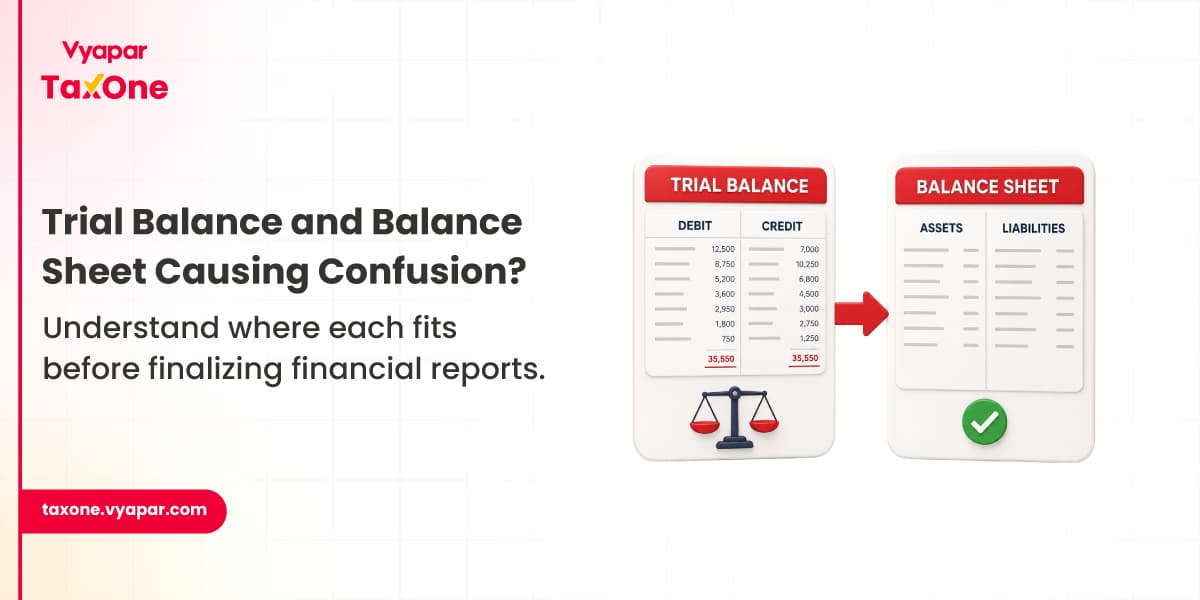
During month-end or year-end closing, it's common to switch between the trial balance and the balance sheet several times.
That's often where the confusion begins.
We've often seen accounting teams use a trial balance to review financial position or assume that because the trial balance is balanced, the balance sheet is ready. In reality, both documents play different roles in the accounting cycle.
Knowing where the trial balance ends and where the balance sheet begins can save hours of unnecessary review, reduce unnecessary corrections, and make financial reporting much smoother.
Think of the trial balance as a checkpoint, not the final output. Before financial statements are prepared, accounting teams use them to verify that ledger balances are mathematically correct and that debits and credits match.
The balance sheet comes after that. Once adjustment entries, reconciliations, and account classifications are complete, those balances are organised into assets, liabilities, and equity to present the company's financial position.
In practice, the workflow usually follows this sequence:
Skipping or rushing any of these steps often creates reporting issues later in the closing cycle.
The confusion usually isn't about accounting principles. It happens because both reports are generated from the same books and are often reviewed during the same reporting cycle.
What teams sometimes miss is that a balanced trial balance is only one step in preparing accurate financial statements.
Here are some of the most common reasons:
As transaction volumes increase, these issues become much more visible during month-end reporting.
| Feature | Trial Balance | Balance Sheet |
|---|---|---|
| Primary Purpose | Verify ledger accuracy before financial reporting | Present the organization's financial position |
| Users | Internal accounting and finance teams | Management, auditors, lenders, investors, and regulators |
| Stage in Workflow | Before financial statements | After adjustments and financial statement preparation |
| Account Presentation | Lists all ledger balances | Groups balance into Assets, Liabilities, and Equity |
| Validation Focus | Total debits equal total credits | Assets = Liabilities + Equity |
| Reporting Use | Internal verification | External and management reporting |
Balanced books do not always mean accurate financial reporting.
Some of the issues we frequently see during reconciliation include:
Many of these issues are discovered only during audit reviews or while preparing the final balance sheet.
Many finance teams reduce these last-minute surprises by following a structured month-end close process that ensures reconciliations, adjustments, and reviews are completed before financial statements are finalized.
Consider a manufacturing business processing more than 4,000 invoices every month across multiple locations.
The accounting team generates the trial balance and confirms that debit and credit totals match. However, while preparing the balance sheet, they identify that inventory valuation adjustments and depreciation entries are still pending.
Although the trial balance is technically balanced, the balance sheet cannot be finalized until these adjustments are completed, delaying management reporting by several days.
A CA firm managing accounting for nearly 25 business clients reviews the trial balances received from each client before preparing financial statements.
During review, they notice several loan balances posted under current liabilities instead of long-term liabilities. The trial balances themselves are balanced, but the balance sheets require additional review and corrections before they can be shared with clients.
Most of the effort goes into reviewing classifications rather than correcting debit-credit mismatches.
One thing we've noticed is that reporting issues rarely come from the trial balance itself. More often, they appear while converting those ledger balances into financial statements.
As businesses grow, accounting teams spend far more time reviewing classifications, adjustments, reconciliations, and supporting schedules than checking whether debits and credits match.
In most organisations, preparing the balance sheet follows a fairly standard sequence.
A structured reporting workflow generally looks like this:
The biggest delays usually occur between Steps 4 and 8, where manual tracking across Excel sheets, emails, and multiple systems slows down the reporting cycle.
Before finalizing financial statements, accounting teams should verify:
Along with these checks, performing balance sheet reconciliation helps verify that ledger balances, supporting schedules, and account classifications are accurate before financial statements are finalized.
Completing these checks before preparing the balance sheet significantly reduces last-minute corrections.
The trial balance and the balance sheet aren't alternatives; they're two different stages of the same accounting process.
One helps you verify whether the books are balanced. The other shows the company's financial position after all necessary reviews and adjustments have been completed.
Both reports are part of the broader accounting cycle, where each stage builds on the accuracy of the previous one before financial statements are prepared.
As transaction volumes grow, this transition from ledger verification to financial reporting becomes more challenging. Accounting teams often need to manage adjustments across multiple branches, GST registrations, reporting periods, and supporting schedules. Manual tracking through spreadsheets and disconnected systems can make it difficult to monitor what has been completed and what still requires review, leading to delays during month-end and audit cycles.
We've seen many CA firms and finance teams gradually move toward more structured accounting workflows as reporting complexity increases. This is the kind of operational challenge that structured systems like Vyapar TaxOne are designed to address by providing better visibility into data preparation, validation, and reconciliation before financial statements are finalized.
Yes. Missing adjustments, incorrect classifications, or pending reconciliations can affect financial statements even when debits and credits match.
The trial balance helps review ledger balances, while the balance sheet presents the organization's financial position after adjustments.
No. It confirms mathematical accuracy but cannot detect every accounting or classification error.
Yes. Financial statements should always be prepared after all necessary accounting adjustments are completed.
Most delays occur during reconciliations, account reviews, adjustment entries, and supporting document verification rather than debit-credit balancing itself.
The trial balance validates ledger postings, while the balance sheet communicates the organization's financial position.


Tax Professional & Business Finance Expert

Tax Professional & Business Finance Expert

Tax Professional & Business Finance Expert