 Is Now Vyapar TaxOne | Same Trust, New Name!
 AI Weapon for Financial Soldiers
Vyapar TaxOne


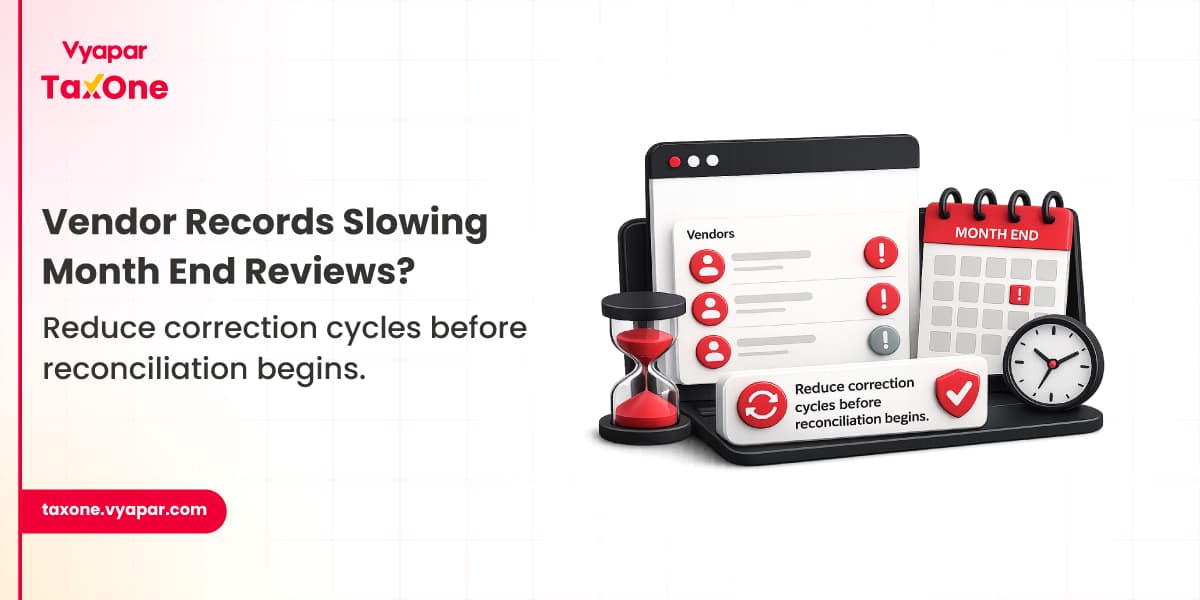
Month-end often appears manageable until accounting teams begin reconciling purchase ledgers and discover issues that have built up throughout the month.
Duplicate vendor masters, pending invoices, inconsistent ledger mapping, and missing supporting documents usually become visible at this stage.
By then, these issues start affecting multiple accounting activities at the same time. Purchase vouchers require corrections, approvals remain pending, payment schedules need revision, and reconciliation takes longer than planned.
For accounting teams managing increasing transaction volumes, vendor management is not only about maintaining supplier records. It is about ensuring that every purchase transaction moves smoothly through bookkeeping, approvals, reconciliation, and compliance without repeated manual intervention.
As businesses grow, the same vendor master is referenced across purchase accounting, payment processing, reconciliation, GST validation, audit preparation, and financial reporting.
This is why experienced finance teams review vendor workflows continuously instead of waiting until month-end to identify issues.
Vendor master inconsistencies often remain unnoticed during daily booking.
They usually become visible when purchase reconciliation, payment reviews, or GST validation require records from multiple workflows to match.
Vendor master records are connected with purchase accounting, payment processing, reconciliation, GST-related verification, audit preparation, and financial reporting.
When these records remain consistent, accounting work moves smoothly across departments.
When they do not, every downstream activity requires additional validation and review.
Accounting teams typically manage vendor-related activities such as:
These activities may appear independent during daily bookkeeping.
However, they become closely connected as reporting deadlines approach.
Most vendor management issues are not caused by a single mistake.
They develop gradually as accounting work passes through different people, departments, spreadsheets, approval chains, and accounting systems.
Several operational factors contribute to these delays.
When multiple users maintain vendor records, the same supplier may be created using different naming conventions or ledger structures.
These inconsistencies often remain unnoticed during routine bookkeeping.
They usually become visible only when reconciliation or audit reviews begin.
Many finance teams receive invoices several days after goods or services have already been delivered.
As a result, purchase entries may be recorded later than expected, increasing pressure on reconciliation and payment planning.
Improving invoice processing workflows can help accounting teams organise invoice capture, validation, approvals, and recording more systematically.
This reduces delays that later affect reconciliation and payment planning.
As transaction volumes increase, selecting the correct purchase ledger for every voucher becomes increasingly difficult.
Incorrect classifications often remain unnoticed until review cycles begin.
By that time, accounting teams may need to spend additional time correcting entries and validating records.
Purchase invoices frequently wait for operational or management approvals before accounting entries can be recorded.
When approvals move through separate communication channels, pending invoices accumulate throughout the month.
This eventually delays purchase booking and payment schedules.
Supporting invoices, email approvals, vendor agreements, and payment references are often maintained separately.
During reconciliation or audits, accounting teams spend additional time locating the required documentation.
Businesses operating across multiple GST registrations or entities often maintain separate purchase records for each registration or accounting unit.
Without standardised vendor processes, maintaining consistency across registrations becomes increasingly challenging.
Most vendor workflow issues become visible only when accounting teams begin validating records before reporting deadlines.
During regular bookkeeping, individual transactions may appear correct. However, when purchase records, vendor balances, GST details, and supporting documents are reviewed together, inconsistencies begin to surface.
Common operational issues include:
Individually, each issue may appear manageable.
However, together they increase review efforts across bookkeeping, reconciliation, compliance, and financial reporting.
Vendor-related work rarely begins and ends with recording a purchase invoice.
By the time a transaction is reflected in the books, it has usually passed through multiple review points involving operations, procurement, finance, and accounting teams.
A typical workflow often looks like this:
The workflow may look simple when viewed as individual steps.
The challenge appears when approvals, documentation, and accounting entries move through different teams.
In practice, delays at any stage affect the remaining activities.
A pending invoice delays purchase booking.
Incorrect ledger mapping creates additional reconciliation work.
Missing approvals postpone payment processing.
By month-end, accounting teams are often managing multiple correction cycles instead of completing planned reviews.
Vendor workflows rarely fail because of one major issue.
More often, small operational gaps accumulate across vendor master maintenance, invoice validation, approval tracking, ledger mapping, and document management.
These gaps usually appear when vendor creation, invoice verification, approvals, and accounting entries are handled by different teams or through separate processes.
By the time purchase records, vendor balances, and supporting documents are reviewed together, accounting teams often need to spend additional time identifying the original source of the mismatch.
Individually, these issues may appear manageable during daily bookkeeping.
Together, they create additional correction work during reconciliation, GST review, and month-end reporting.
A CA firm managing more than 15 GST registrations maintained separate vendor masters for each client entity.
Over time, identical suppliers were created using slightly different naming conventions across businesses.
The issue remained unnoticed during routine bookkeeping because each entity was reviewed independently.
When purchase registers were consolidated for GST reconciliation, accounting teams spent several days identifying duplicate vendor masters, correcting ledger mappings, and validating outstanding balances before returns could be finalised.
The operational challenge began during vendor master maintenance rather than reconciliation itself.
A manufacturing business processed over 4,000 purchase invoices each month across multiple plants.
Most invoices reached the finance team on time, but supporting approvals arrived gradually through emails and operational teams.
As month-end approached, accounting teams were simultaneously waiting for approvals, preparing purchase vouchers, reviewing vendor balances, and finalising reconciliation.
The accounting process itself was not complex.
The delay resulted from fragmented approval and documentation flows, where approvals entered the workflow at different stages.
This forced finance teams to revisit the same transactions repeatedly before closing the books.
We often see duplicate vendor masters remaining unnoticed throughout routine bookkeeping.
They usually surface only when purchase registers are consolidated across multiple GST registrations during month-end reconciliation.
At lower transaction volumes, accounting teams usually identify inconsistencies during routine reviews.
Another common observation is that finance teams rarely struggle because they lack accounting knowledge.
The challenge is usually operational.
Information reaches different teams at different times, approvals move through separate channels, and purchase records are maintained across multiple systems.
By the time accounting teams consolidate everything during month-end, correcting inconsistencies requires significantly more effort than preventing them earlier in the workflow.
Accounting teams generally experience smoother month-end cycles when vendor workflows are reviewed throughout the accounting period instead of only during reconciliation.
Regular checks help identify inconsistencies earlier and reduce the amount of correction work required during reporting periods.
Some practical practices include:
Following these practices helps reduce correction work later in the accounting cycle and makes reconciliation more predictable.
Before the month-end review begins, accounting teams can verify the following:
✓ Vendor masters are reviewed for duplicate records.
✓ GSTIN details have been validated for newly added vendors.
✓ Purchase invoices have supporting documentation.
✓ Ledger mapping follows internal accounting standards.
✓ Pending approvals have been completed.
✓ Outstanding vendor balances have been reviewed.
✓ Purchase vouchers awaiting correction have been resolved.
✓ Supporting documents are available for audit and reconciliation.
✓ Vendor records remain consistent across all GST registrations or business entities.
Completing these checks regularly helps reduce manual corrections during reconciliation and financial reporting.
Vendor-related accounting issues rarely begin during reconciliation.
In most organisations, they develop much earlier through inconsistent vendor masters, delayed approvals, fragmented documentation, and manual purchase workflows.
While these issues may remain manageable at lower transaction volumes, they become increasingly difficult to control as businesses expand across multiple GST registrations, business entities, locations, or accounting teams.
At this stage, finance teams are no longer managing only vendor masters.
They are simultaneously coordinating invoice reviews, purchase accounting, ledger consistency, supporting documents, payment approvals, reconciliation, and statutory reporting.
As transaction volumes increase, teams often spend more time validating records than recording them.
Spreadsheets, email approvals, and disconnected record-keeping can create additional review work instead of simplifying daily accounting activities.
Many organisations begin evaluating accounting process automation when manual coordination starts affecting operational consistency.
A structured automation approach can help standardise repetitive accounting activities, improve workflow visibility, and reduce repeated validation efforts across purchase accounting, approvals, and reconciliation processes.
The objective is rarely to change established accounting processes.
It is to reduce repeated validation work, improve visibility across purchase accounting activities, and make month-end reviews more predictable.
These are the kinds of workflow challenges where structured systems such as Vyapar TaxOne are often considered when organisations need more consistent vendor-related accounting workflows without changing established accounting practices.
Most inconsistencies remain unnoticed while transactions are being recorded individually.
They become visible only when purchase registers, vendor ledgers, outstanding balances, and GST records are reviewed together during reconciliation.
Duplicate records often result from inconsistent vendor creation across different users, branches, or business entities.
Without periodic reviews, these duplicates remain in the accounting system until reconciliation or audit checks identify them.
Accounting entries frequently depend on operational approvals or supporting documentation.
When approvals move through separate communication channels, purchase booking and payment planning are naturally delayed.
Corrections usually originate earlier in the accounting cycle through inconsistent ledger mapping, delayed invoices, duplicate vendor records, or incomplete documentation.
The reconciliation process often highlights these issues rather than creating them.
Most accounting teams benefit from reviewing vendor masters, pending approvals, and supporting documents throughout the month instead of waiting until month-end validation.
Business growth usually increases invoice volumes, vendor records, business entities, and GST registrations simultaneously.
Manual coordination that worked earlier often becomes difficult to maintain consistently at higher transaction volumes.

Tax Professional & Business Finance Expert
Tax Professional & Business Finance Expert
Tax Professional & Business Finance Expert